
The immediate focus for Meta will be on user adoption and content generation within Pocket. The app's design, centered on easy creation and sharing of interactive minigames, suggests an attempt to foster a new form of user-generated content that leverages generative AI capabilities. Expect Meta to closely monitor engagement metrics and the types of 'gizmos' users create. The company will likely evaluate how well Pocket integrates into its broader AI strategy, particularly as it seeks to embed AI tools across its family of apps. A key challenge will be managing content moderation for AI-generated interactive experiences, a complex task that Meta has faced with other AI-driven features.
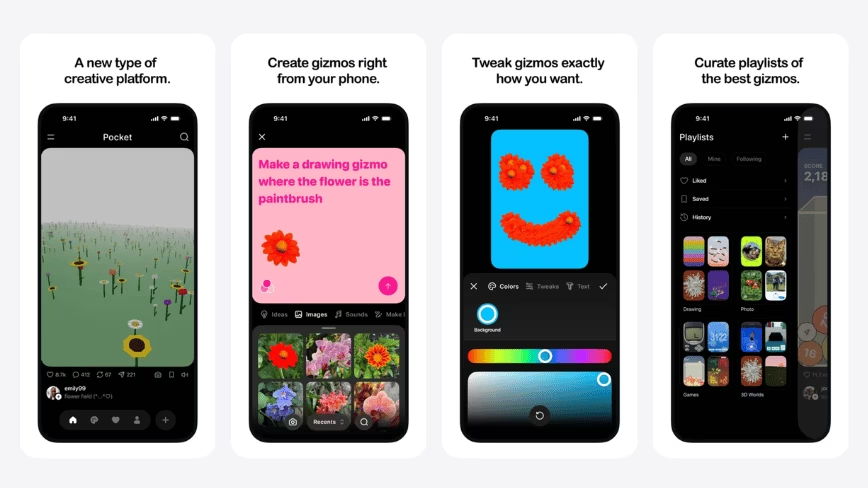
Image: courtesy of Thenextweb
Meta's Quiet Pocket Launch and the Strategic Shift to Acquiring Talent, Not Companies
Meta has launched Pocket, a new app allowing users in the US to create interactive minigames called 'gizmos' using AI prompts. The launch, which occurred on August 21, 2026, was notably quiet, without a formal press release. Pocket emerged from a team Meta hired in March 2026, formerly behind the 'Gizmo' app developed by Atma Sciences. The original Gizmo app was shut down on the same day Pocket went live, signaling Meta's preference for integrating specialized talent and technology directly rather than pursuing full corporate acquisitions.
Outlook
Background
On August 21, 2026, Meta quietly rolled out Pocket nationwide in the US, an application designed to let users create and share what it calls 'gizmos.' These are small, interactive minigames generated through text prompts. The app's emergence follows Meta's decision in March 2026 to hire the core team responsible for the original 'Gizmo' app, developed by a company called Atma Sciences. Founded by former Snapchat engineers, Atma Sciences had previously built a similar platform. On the very day Pocket became widely available, the original Gizmo app ceased operations.
This move by Meta is significant because the company did not acquire Atma Sciences outright. Instead, it opted to bring the talent and license the underlying technology, a distinction that offers a different strategic playbook than a full corporate merger. Acquiring a team and its intellectual property components allows for a more targeted integration, potentially reducing the overhead and complexities often associated with larger acquisitions. This approach suggests a focus on specific capabilities and human capital rather than entire business structures. Early detections of the app, possibly a soft launch, were noted by app intelligence firms like Appfigures as early as June 29, 2026, though the nationwide rollout and the corresponding shutdown of the original app happened later.
Precedents
Meta has a long history of experimenting with new standalone applications and features, often with mixed results. The company has a pattern of launching apps to test new social mechanics or content formats, sometimes integrating successful elements into its core platforms (Facebook, Instagram, WhatsApp) and discontinuing those that fail to gain traction. Examples include the short-video app Lasso, which aimed to compete with TikTok, or various experimental apps from its New Product Experimentation (NPE) team.
This strategy of acquiring talent or specific technology without a full company buyout is not new for Meta or the tech industry at large. It allows established giants to absorb innovative ideas and skilled personnel quickly, bypassing the regulatory scrutiny and integration challenges that can accompany large-scale mergers and acquisitions. For example, Meta has historically acquired smaller teams for their expertise in areas like virtual reality or specific AI applications, folding them into larger internal projects. The quiet nature of Pocket's launch also aligns with Meta's recent tendency to soft-launch or gradually roll out new AI-centric features, such as the 'Vibes' feed in Meta AI or AI-powered profile photo animations, testing the waters before a broader public push. This approach allows for iterative development and real-time user feedback without the pressure of a high-profile debut.
Meta's launch of Pocket is more than just another app; it signals a deeper strategic intention regarding generative AI and the future of user engagement. By focusing on interactive minigames, Meta is exploring how AI can move beyond static images or text to create dynamic, playable experiences. This could unlock new avenues for user-generated content, potentially increasing time spent on Meta's platforms and attracting a new demographic interested in casual game creation.
The decision to hire the team behind Gizmo rather than acquire Atma Sciences itself highlights a refined approach to talent acquisition. It suggests Meta is prioritizing specific, high-value engineering and product expertise in niche AI areas, allowing for more agile integration and potentially lower financial and legal overhead compared to a full M&A. This model could become a blueprint for how large tech companies onboard innovation in a rapidly evolving AI landscape.
For the broader tech industry, Pocket represents a test case for the commercial viability and scalability of AI-powered interactive content. If successful, it could spur other platforms to invest more heavily in similar tools, intensifying competition in the generative AI space. However, the quiet launch also implies a cautious approach, acknowledging the potential challenges of moderating AI-generated content and ensuring a safe, positive user experience, especially with interactive elements.
Scenarios
Analysis1. Pocket gains significant traction and becomes a new pillar for Meta's AI content strategy: If users embrace the creation and sharing of 'gizmos,' Pocket could evolve into a vibrant platform for interactive social experiences. This could lead to its features being integrated more deeply into Facebook or Instagram, or even becoming a standalone revenue stream through advertising or in-app purchases. The success of Pocket would validate Meta's talent acquisition strategy and its investment in generative AI for consumer applications.
2. Pocket struggles with user adoption or faces significant moderation challenges, leading to its eventual integration or sunset: The history of new app launches is littered with those that fail to find a sustainable audience. If Pocket does not achieve critical mass, or if the complexities of moderating AI-generated interactive content prove too difficult to manage at scale, Meta might choose to integrate its core technology into other existing products or, in a less likely scenario, discontinue the app. The quiet launch provides Meta with an exit strategy that minimizes public perception impact.
3. The 'talent-over-acquisition' model becomes a preferred strategy for Meta's future innovation efforts: If the integration of the Gizmo team and technology proves efficient and effective, Meta may increasingly favor hiring specialized teams and licensing specific IP components over full company acquisitions. This could reshape how startups with innovative AI or interactive content ideas are approached by major tech players, emphasizing talent and technology transfer over traditional M&A processes.
Timeline
March 2026
Meta Hires Gizmo Team
Meta hired the team responsible for the original 'Gizmo' app, developed by Atma Sciences, a company founded by ex-Snapchat engineers.
June 29, 2026
Pocket Soft Launch Detected
App intelligence firm Appfigures reportedly detected an early, quiet rollout or soft launch of the Meta Pocket app on iOS and Android.
August 21, 2026
Meta Pocket Nationwide Launch; Original Gizmo App Shuts Down
Meta officially launched Pocket nationwide in the US, allowing users to create AI-generated interactive minigames. On the same day, the original 'Gizmo' app, from which Pocket's core technology and team originated, was shut down.
Frequently Asked Questions
Meta Pocket is a new app launched by Meta that allows users to create and share small, interactive minigames, referred to as 'gizmos,' by providing text prompts. It leverages generative AI to bring these interactive experiences to life.
Discussion
Be the first to share your thoughts.