
The successful deployment and sustained performance of Perseverance's autonomous driving system is likely to set a new standard for robotic planetary missions. Expect future rovers and landers to integrate even more sophisticated AI-driven navigation and decision-making tools. This shift will likely enable missions to cover greater distances, explore more complex terrains, and react to unforeseen challenges with less direct human intervention. The immediate consequence will be faster data acquisition and potentially more ambitious scientific objectives for upcoming probes, as the bottleneck of Earth-to-Mars communication delays is significantly reduced. Over the longer term, this technology could form the backbone for infrastructure deployment or even human habitat preparation on other celestial bodies.
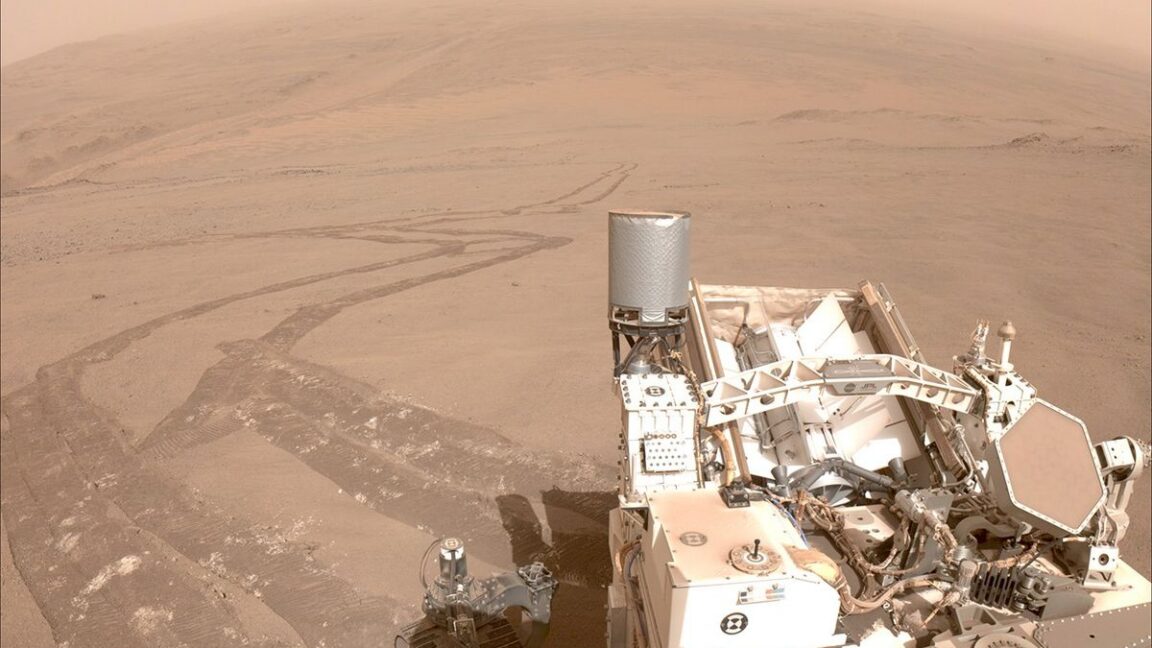
Image: courtesy of Ars Technica
Beyond the Record: How Perseverance's Self-Driving Redefines Future Mars Exploration
NASA's Perseverance rover has achieved a significant milestone, completing over 90% of its journey across Mars' Jezero Crater autonomously. This achievement, first reported in April 2022, marks a substantial leap in robotic self-navigation capabilities for deep-space missions, moving away from the more human-intensive control methods of earlier rovers like Curiosity and Opportunity. The success of Perseverance's advanced algorithms and hardware suggests a profound shift in how future planetary explorations will be designed and executed.
Outlook
Background
The Perseverance rover, a key component of NASA's Mars 2020 mission, landed in Jezero Crater on Mars in February 2021. Its primary objectives include seeking signs of ancient microbial life, characterizing the planet's geology and past climate, and collecting carefully selected rock and soil samples for a planned return to Earth. What sets Perseverance apart from its predecessors is its advanced 'AutoNav' system, which allows it to make real-time navigation decisions. While earlier rovers like Curiosity and Opportunity required human operators on Earth to painstakingly plan each drive, often sending individual commands for every few meters, Perseverance can chart its own course between designated waypoints.
This autonomous capability means the rover uses its onboard cameras and processors to identify hazards, map terrain, and determine the safest and most efficient path forward, all without waiting for instructions from Earth. The delay in communication between Mars and Earth, which can range from 3 to 22 minutes depending on planetary alignment, historically imposed severe limitations on how quickly rovers could move. By offloading much of the decision-making to the rover itself, Perseverance effectively bypasses this latency, enabling it to cover ground far more efficiently. The milestone of driving 90% autonomously, as reported by NASA's Jet Propulsion Laboratory (JPL) in April 2022, represents a critical validation of this technological approach, proving that complex robotic systems can operate with significant independence millions of miles away.
Precedents
Space exploration has a long history of gradual automation, evolving from purely human-controlled systems to increasingly independent robotic agents. The earliest lunar and planetary probes were essentially remote-controlled extensions of Earth-bound scientists. The Viking landers in the 1970s, for instance, operated on pre-programmed sequences and required constant human oversight for adjustments.
The Mars Pathfinder mission in 1997, with its Sojourner rover, introduced a rudimentary form of hazard avoidance, allowing the tiny robot to detect obstacles and stop, awaiting human commands. This was a significant step, but still heavily reliant on Earth-based control.
Subsequent rovers like Spirit, Opportunity, and Curiosity advanced this further, incorporating more sophisticated hazard detection and limited 'go-to' capabilities where they could navigate short distances to a specified point while avoiding immediate dangers. However, these systems still required human planners to define the general route and intervene frequently. Every turn, every rock avoidance, often meant a day's worth of planning and communication delays.
Perseverance’s achievement, reported in April 2022, represents a qualitative leap. It’s not just avoiding obstacles; it’s planning its own path over long stretches, dynamically adapting to unknown terrain. This shift mirrors the progression seen in autonomous vehicles on Earth, moving from advanced driver-assistance systems to truly self-driving capabilities. The historical pattern shows a clear trend towards greater robotic independence, driven by the practical limitations of distance and communication delay, and the increasing complexity of scientific objectives. Each successive generation of planetary rover has pushed the boundaries of what a robot can achieve without constant human input, culminating in Perseverance's current performance.
The success of Perseverance's autonomous driving system changes the fundamental calculus of deep-space exploration. Historically, the speed of Martian surface operations has been dictated by the speed of light. Every command sent from Earth takes minutes to arrive, and every response takes minutes to return, creating a cumbersome, slow-motion ballet between human operators and distant machines. Perseverance's ability to largely manage its own navigation shatters this constraint.
This means future missions can cover vastly more ground in the same amount of time, significantly increasing the scientific return for each mission. Instead of spending days planning a few meters of movement, scientists can focus on higher-level strategic objectives, knowing the rover can execute the tactical details itself. This efficiency directly impacts mission costs, as fewer operational hours are required from highly specialized teams on Earth.
Beyond efficiency, this level of autonomy is crucial for exploring more challenging and hazardous environments that might be too risky or too complex for remote human control. Think of navigating lava tubes, steep crater walls, or polar ice caps where every second counts and immediate reactions are vital.
Furthermore, the technology developed for Perseverance has direct implications for human missions to Mars. Before humans can establish a permanent presence, autonomous systems will likely be needed to scout locations, deploy habitats, prepare resources, and manage logistics. The ability for robots to operate with minimal human oversight is not just an enhancement; it is a prerequisite for sustained human activity beyond Earth. This isn't just about a rover driving itself; it's about laying the groundwork for a future where humanity lives and works on other planets.
Scenarios
AnalysisThe validated success of Perseverance’s autonomous driving capabilities opens up several significant pathways for the future of space exploration:
1. Accelerated Scientific Discovery on Mars and Beyond: The immediate and most apparent outcome is that future robotic missions to Mars, and potentially other planets or moons like Europa or Titan, will be able to cover much larger areas and perform more complex scientific tasks. With less time spent waiting for commands, rovers could explore more diverse geological features, gather a greater variety of samples, and conduct longer-duration experiments. This could lead to a faster accumulation of data, increasing the chances of discovering signs of extraterrestrial life or understanding planetary formation. This also implies that missions could be less constrained by landing site precision, as robots can traverse longer distances to reach target areas.
2. Enabling Human Missions and Infrastructure: The technology pioneered by Perseverance is an essential building block for human exploration. Autonomous rovers could precede human crews to Mars, scouting optimal landing sites, identifying potential hazards, and even beginning the construction or deployment of habitats and resource extraction equipment. This pre-positioning and preparation by self-driving robots would dramatically reduce the risks and logistical complexities for the first human explorers. The same principles could apply to establishing bases on the Moon or mining asteroids, where reliable autonomous systems could perform dangerous or repetitive tasks without human presence.
Timeline
Frequently Asked Questions
Discussion
Be the first to share your thoughts.