
This direct engagement model, driven by national leaders, suggests a future where competition for critical AI infrastructure intensifies and becomes more reliant on individual rapport. Other nations may try to replicate this approach, potentially leading to a more fragmented and personality-driven global tech investment landscape. The influence of tech giants in national strategic planning also appears set to grow as governments actively court their capital and expertise.
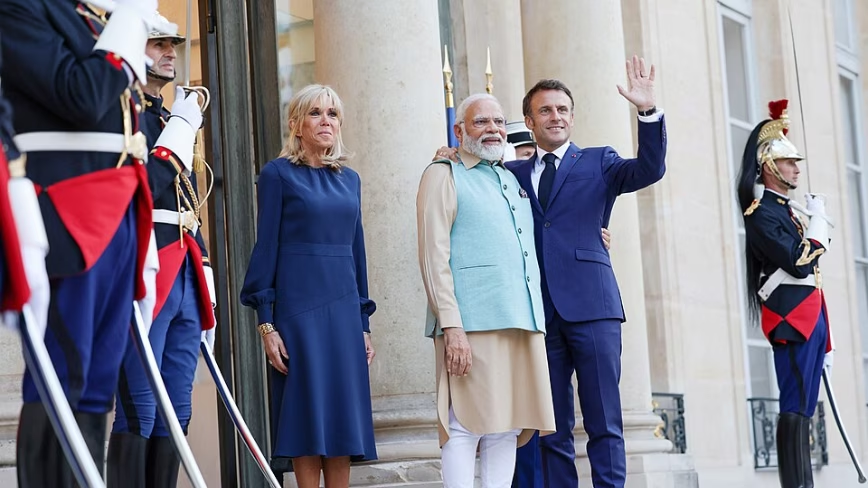
Image: courtesy of Thenextweb
The New Playbook for AI Power: How Personal Diplomacy is Reshaping Global Tech Investment
French President Emmanuel Macron and Indian Prime Minister Narendra Modi have secured billions in AI infrastructure investment through direct, personal appeals to tech CEOs, effectively bypassing traditional diplomatic channels. Macron convinced SoftBank to commit €75 billion to France for AI data centers, while Modi secured a $48 billion pledge from Amazon for India. This shift highlights a new, highly personalized approach to the global race for AI leadership, where direct relationships with tech titans are proving as critical as policy incentives.
Outlook
Background
The global competition for artificial intelligence leadership is fundamentally an infrastructure race. AI models demand immense computing power, which translates into a need for vast data centers, stable energy grids, and robust digital infrastructure. Building these facilities requires colossal capital investment, often in the tens of billions of dollars, and access to advanced technology and expertise. Traditionally, governments have attracted such investments through a mix of tax incentives, regulatory frameworks, workforce development programs, and diplomatic efforts led by trade ministers or specialized agencies. The scramble is intense because falling behind in AI infrastructure could mean losing out on future economic growth, national security advantages, and technological sovereignty. Many nations are keenly aware that the computing power underpinning AI is as strategically vital as energy or defense capabilities once were, and securing it has become a top priority.
Precedents
Throughout history, significant industrial and technological shifts have often involved governments actively courting private enterprise. In the post-World War II era, nations like Japan and Germany rebuilt their industrial bases with strong government-industry partnerships, particularly in sectors like automotive and electronics. Later, the race for semiconductor manufacturing saw countries offering substantial subsidies and incentives to attract chip fabrication plants, recognizing their strategic importance. Similarly, the early internet era saw governments investing in backbone infrastructure and creating regulatory environments to foster tech growth. However, what Macron and Modi are doing represents a departure in its directness and personalization. Previous patterns involved more institutional lobbying and policy negotiation. While heads of state have always engaged with major industrialists, the intensity and specificity of these personal appeals for foundational digital infrastructure, often bypassing layers of bureaucracy, marks a distinct evolution. It suggests that in an age of rapid technological change and immense private capital, the personal touch of a national leader can cut through more effectively than traditional statecraft.
The fact that national leaders are resorting to text messages and personal meetings to secure billions in AI infrastructure investment is not merely a colorful anecdote; it signals a profound shift in global economic diplomacy and the very nature of state power in the digital age.
First, it highlights the sheer scale and strategic importance of AI infrastructure. These are not just commercial deals; they are foundational investments that will shape national economies, job markets, and geopolitical influence for decades. The capital required is so immense, and the technology so complex, that it often exceeds the capacity or willingness of domestic players alone. This makes global tech titans like SoftBank and Amazon, with their deep pockets and technical expertise, indispensable partners.
Second, this approach allows for speed and directness. Traditional diplomatic channels can be slow, bogged down by committees, competing interests, and bureaucratic processes. A direct appeal from a head of state can bypass these bottlenecks, offering a clear, high-level commitment that reassures investors and accelerates decision-making. Masayoshi Son's comments about Macron's personal involvement underscore that this direct engagement was a critical factor in SoftBank's €75 billion commitment.
Third, it concentrates power. When national leaders personally negotiate these deals, it centralizes control and influence, but it also creates a dependency on those individual relationships. It suggests that a nation's ability to attract cutting-edge technology might increasingly depend on the personal charisma and network of its top leader, rather than solely on the strength of its institutions or the attractiveness of its policy environment. This could create an uneven playing field globally, favoring nations with leaders who can effectively forge these high-stakes personal connections.
Finally, it elevates the political leverage of tech CEOs. When a president or prime minister is personally calling, it grants these corporate leaders an unprecedented level of access and influence in national strategic planning. Their investment decisions become intertwined with national ambitions, giving them a significant seat at the table in shaping future economic and technological trajectories. This dynamic could reshape the balance of power between states and corporations, with tech giants holding increasing sway over national development priorities.
Scenarios
AnalysisThis shift towards highly personalized diplomacy for AI infrastructure could lead to several distinct outcomes across the global economic and geopolitical landscape.
One possible outcome is the widespread adoption of this 'CEO charm offensive' model by other national leaders. Seeing the success of Macron and Modi, governments worldwide may instruct their own heads of state to prioritize direct engagement with tech executives. This could transform international economic diplomacy, making personal rapport and direct access to CEOs a primary tool for attracting high-tech investment. Leaders who are less adept at this kind of personal outreach, or those from smaller economies, might find themselves at a disadvantage in the global AI race.
A second outcome could be the further concentration of AI infrastructure in a few favored nations. If personal relationships and direct appeals become the dominant mechanism for securing these massive investments, then countries with established ties to major tech companies, or those whose leaders can effectively cultivate such relationships, will likely pull ahead. This could exacerbate the digital divide, leaving many developing nations struggling to build the foundational computing power needed to participate fully in the AI economy, thereby reinforcing existing global inequalities in technological capability and economic opportunity.
A third, more complex consequence is the increased leverage of global tech giants over national policy. When a head of state personally courts a CEO for billions, it inherently grants that company significant influence. Tech firms might use this heightened access to advocate for specific regulatory environments, data policies, or tax structures that favor their operations. This could lead to a scenario where national economic strategies are shaped not just by public policy objectives, but also by the specific demands and preferences of a handful of powerful technology corporations, potentially creating a new form of corporate-state partnership where the lines of influence are increasingly blurred.
Timeline
2026-05-XX
SoftBank Announces €75 Billion Investment in France
SoftBank confirms plans to develop 3.1 gigawatts of AI data center capacity in France by 2031, as part of a broader €75 billion program aimed at creating 5 GW of AI infrastructure. This announcement followed sustained personal pitches from French President Emmanuel Macron to SoftBank founder and CEO Masayoshi Son.
2026-07-04
Reports Detail Macron and Modi's Personal Diplomacy
CNBC and other outlets report on the direct, personal involvement of French President Emmanuel Macron and Indian Prime Minister Narendra Modi in securing major AI infrastructure investments. Macron's success with SoftBank and Modi's $48 billion commitment from Amazon are highlighted as examples of this new diplomatic approach.
Frequently Asked Questions
AI infrastructure refers to the physical and digital components necessary to develop, train, and run artificial intelligence systems. This primarily includes high-performance data centers equipped with powerful computer chips (like GPUs), advanced cooling systems, robust power grids, and high-speed network connectivity. These facilities are incredibly expensive to build and operate, but they are essential for handling the massive computational demands of modern AI.
Discussion
Be the first to share your thoughts.