
The immediate consequence of this move will be heightened scrutiny on the specifics of the licensing agreement and the corporate relationship between Intel and Rosaic Labs. Investors and industry observers will likely demand greater transparency regarding the terms of the deal, including any financial arrangements and the extent of Intel's involvement beyond the initial technology transfer. The market will also watch closely for Rosaic's first products, which could offer an early indication of the strategic value Intel expects from this partnership. This deal could also signal a broader shift in Intel's intellectual property strategy, moving away from its historically closed model in certain niche segments.
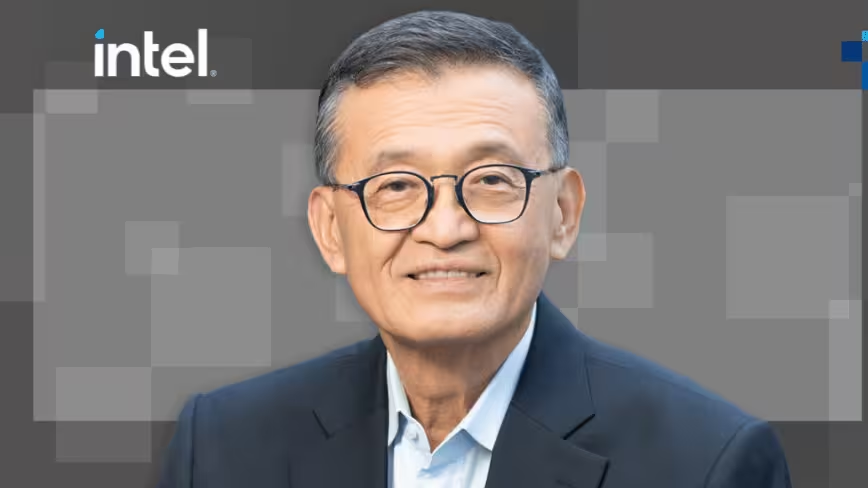
Image: courtesy of Thenextweb
Intel's Atom Chip Gambit: Unpacking the Strategic Shift and Governance Questions Behind a Rare Licensing Deal
Intel, traditionally a staunch protector of its core x86 architecture, has licensed its low-power Atom chip technology to Rosaic Labs, a stealth startup. The deal, which includes access to synthesizable Register-Transfer Level (RTL) code, is highly unusual for the semiconductor giant. It also immediately raises questions about corporate governance, given that Rosaic's CEO, Amarjit Gill, is a long-time co-investor and business partner of Intel's chief executive, Lip-Bu Tan, who joined the company in 2025.
Outlook
Background
Intel's decision to license its Atom chip technology to Rosaic Labs, a company only incorporated in May, marks a significant departure from its long-standing approach to intellectual property. For decades, Intel has fiercely guarded its x86 architecture, the fundamental design that powers most personal computers and servers globally. Licensing portions of this technology, especially the detailed Register-Transfer Level (RTL) code which describes chip logic, is a rare occurrence.
The Atom line of processors is designed for low-power applications, typically found in devices like netbooks, embedded systems, and entry-level computing. These chips compete directly with ARM-based designs, which dominate the mobile and increasingly the server markets through a more open licensing model.
At the heart of the governance questions is the relationship between Intel CEO Lip-Bu Tan and Rosaic Labs CEO Amarjit Gill. Tan joined Intel in 2025 with a mandate to drive a turnaround, focusing on the AI industry and expanding Intel’s foundry services. Gill, meanwhile, is described as a long-time co-investor and business partner of Tan, a connection that immediately triggers concerns about potential conflicts of interest and fairness in the deal-making process. Rosaic Labs itself remains a largely unknown entity, operating in stealth mode, which further fuels speculation about the rationale behind Intel's move.
Precedents
Intel's history is largely defined by its proprietary x86 architecture. Unlike competitors such as ARM Holdings, which thrives on licensing its chip designs to a wide array of manufacturers, Intel has traditionally kept its core technology in-house, designing and manufacturing its own processors. There have been very few instances where Intel has licensed its x86 instruction set, and those were typically under specific regulatory pressures or for highly specialized, limited applications.
The broader semiconductor industry, however, has seen a growing trend towards modularity and IP sharing, especially in areas where specialized solutions are needed or where a company seeks to expand its ecosystem without committing full manufacturing resources. ARM's success with its licensing model has often been cited as a contrast to Intel's integrated approach. This recent move by Intel, while specific to the Atom line, could be interpreted as a cautious step towards adopting a more flexible IP strategy, perhaps acknowledging the need to compete differently in segments where its traditional model has struggled to gain traction against ARM.
In terms of corporate governance, deals involving close associates of a CEO often draw comparisons to past instances of related-party transactions. These situations have historically led to questions about transparency, fair valuation, and whether the deal truly serves the best interests of the company and its shareholders, or if it primarily benefits specific individuals.
This deal matters for several critical reasons, touching on Intel's strategic direction, its competitive standing, and the integrity of its corporate governance.
For Intel, the licensing of Atom technology suggests a re-evaluation of how it monetizes its extensive intellectual property. Under CEO Lip-Bu Tan, who arrived in 2025, Intel has been pursuing a turnaround focused on AI and its foundry business. If successful, this rare licensing could open new avenues for Intel to generate revenue from its vast patent portfolio without the full burden of product development and manufacturing in specific niche markets. It could also be an attempt to expand the reach of x86 in low-power segments where ARM currently dominates, effectively creating a proxy for ecosystem expansion. However, a misstep could dilute the value of its IP or, worse, create a perception that Intel is ceding ground in certain areas.
The governance implications are equally significant. The close personal and professional ties between Intel's CEO and Rosaic's CEO immediately invite scrutiny from shareholders, regulators, and the public. Such relationships can erode trust if not managed with absolute transparency and strict ethical oversight. Any perception of favoritism or terms not at arm's length could lead to legal challenges, reputational damage, and a loss of investor confidence, potentially hindering Tan’s broader turnaround efforts.
For the wider semiconductor industry, this move could signal a subtle but important shift in Intel's competitive strategy. If this licensing model proves effective, it might prompt other legacy chipmakers to reconsider how they leverage their IP in an increasingly fragmented and specialized market, especially as pressure from agile competitors like Nvidia, AMD, and Arm continues to intensify.
Scenarios
AnalysisThere are several plausible paths this unusual licensing deal could take, each with different implications for Intel and the broader market.
One possible outcome is that the partnership with Rosaic Labs proves to be a strategic success for Intel. Rosaic, leveraging Intel's Atom technology, could develop innovative low-power solutions that expand the reach of the x86 architecture into new or underserved markets. This could allow Intel to monetize its IP more effectively, generate new revenue streams, and indirectly strengthen its ecosystem against ARM-based competitors without direct investment in those specific product lines. Such a success could validate CEO Lip-Bu Tan’s bold strategic vision and potentially lead to further, carefully considered IP licensing deals in the future, positioning Intel as a more flexible and adaptable player in the semiconductor space. The governance questions would likely fade if the commercial benefits are clear and substantial.
Conversely, the deal could face significant headwinds, particularly regarding corporate governance. If the terms of the agreement are perceived as overly favorable to Rosaic or if the relationship between Tan and Gill leads to accusations of conflicts of interest, Intel could face shareholder lawsuits, regulatory investigations, and a severe blow to its reputation. This could distract management from its core turnaround efforts, erode investor confidence, and make it harder for Intel to attract top talent or secure future partnerships. Furthermore, if Rosaic Labs fails to deliver commercially viable products, the entire exercise could be seen as a costly distraction, effectively diluting Intel's valuable IP without yielding any tangible benefits.
A third outcome is a more muted, niche success. Rosaic Labs might find some traction in a very specific segment of the low-power market, but without broad impact on Intel's overall revenue or strategic direction. In this scenario, the governance concerns might subside over time if no significant impropriety is found, but the deal would not fundamentally alter Intel's competitive landscape. It would simply be a minor experiment in IP monetization, neither a major triumph nor a catastrophic failure, leaving Intel to continue its broader turnaround efforts through other initiatives.
Timeline
2025
Lip-Bu Tan Joins Intel as CEO
Lip-Bu Tan takes over as CEO of Intel, tasked with leading a turnaround focused on AI and expanding the company's foundry business.
May 2026
Rosaic Labs Incorporated
The stealth startup Rosaic Labs Inc. is incorporated, with Amarjit Gill as its CEO.
July 30, 2026
Intel Licenses Atom Chip Technology to Rosaic Labs
Intel announces it has granted Rosaic Labs access to its Atom processor technology, including synthesizable Register-Transfer Level (RTL) code, a rare move for the company.
Frequently Asked Questions
Intel Atom chips are a line of low-power, low-cost microprocessors designed primarily for devices where energy efficiency is critical. This includes products like netbooks, embedded systems, entry-level computers, and some Internet of Things (IoT) applications. They offer less performance than Intel's flagship Core processors but consume significantly less power.
Discussion
Be the first to share your thoughts.