
Expect Humanoid to accelerate its production timeline and expand its industrial deployments, leveraging Bosch's manufacturing capabilities and supply chain expertise. The company will likely focus on fulfilling its substantial pre-order pipeline and demonstrating the real-world efficiency of its KinetIQ AI system in factory settings. The partnership also signals a broader trend of established industrial players collaborating with agile robotics startups to capture the emerging market for advanced automation.
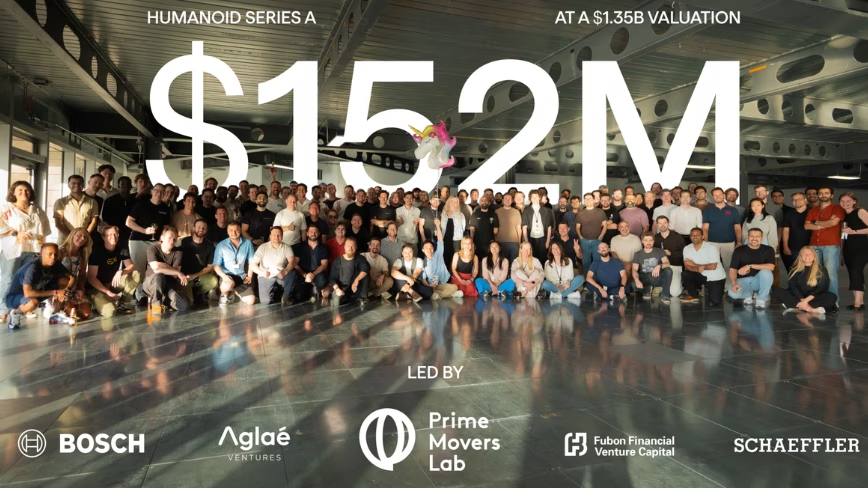
Image: courtesy of Thenextweb
Beyond the Billion-Dollar Valuation: What Bosch's Manufacturing Power Means for Humanoid's Industrial Robot Ambitions
London-based robotics startup Humanoid has secured $152 million in Series A funding, pushing its valuation to $1.35 billion and making it Europe's first pure-play humanoid robotics unicorn. The round, led by Prime Movers Lab, included strategic participation from industrial giant Bosch, which will manufacture Humanoid's wheeled robots and supply key components. This partnership is poised to accelerate Humanoid's market entry, leveraging Bosch's global manufacturing infrastructure to scale production of its AI-powered industrial robots, which already boast 34,000 pre-orders and a $2.4 billion commercial pipeline.
Outlook
Background
Humanoid, a London-based company founded just two years ago, specializes in AI-powered industrial humanoid robots designed to perform physical tasks in complex environments. Yesterday, the company confirmed it raised $152 million in a Series A round, bringing its total funding to $270 million and securing a valuation of $1.35 billion. This makes Humanoid Europe's first pure-play humanoid robotics unicorn. The funding round was led by Prime Movers Lab, a venture firm known for its investment in Figure AI, and saw participation from Schaeffler, Fubon Financial Holding Venture Capital, Aglaé Ventures (the investment arm of LVMH chairman Bernard Arnault), and significantly, Robert Bosch GmbH.
Crucially, Bosch's involvement extends beyond a financial stake. Bosch will act as Humanoid's contract manufacturing partner through its subsidiary, Robert Bosch Robotics GmbH. This arrangement means Bosch will not only build Humanoid's robots at scale but also supply essential components and provide strategic consulting and technical expertise. Humanoid has already completed nine industrial deployments with Fortune 500 partners and has secured approximately 34,000 robot pre-orders, representing a commercial pipeline valued at $2.4 billion. This operational backing from a major global manufacturer like Bosch positions Humanoid as a significant player in the rapidly evolving industrial robotics sector.
Precedents
The robotics industry has a long-standing challenge: scaling from innovative prototype to mass production. Manufacturing complex hardware, especially advanced robots, demands substantial capital, highly specialized facilities, and intricate supply chain management. Many promising robotics firms historically encounter a 'valley of death' between the research and development phase and achieving commercial viability, often due to these production hurdles.
Partnerships with established industrial manufacturers, such as the one forged between Humanoid and Bosch, represent a critical strategy to de-risk this transition. This model allows startups to concentrate their resources on their core strengths – in Humanoid's case, its proprietary AI and robotics development – while outsourcing the capital-intensive and logistically complex aspects of large-scale production. While contract manufacturing is common in sectors like electronics, it is less frequent for a major industrial conglomerate to commit to manufacturing for an early-stage robotics firm at this scale, especially while also acting as a strategic investor and component supplier. This integrated approach creates a deeper relationship than a typical vendor agreement, echoing the strategic alliances seen in other high-tech sectors where specialized expertise meets manufacturing might.
This deal fundamentally changes the calculus for industrial robotics startups. Humanoid is not just another company that has raised a significant funding round; it has secured a direct and robust pathway to mass production through Bosch. This arrangement significantly reduces the operational hurdles and capital expenditure typically associated with scaling the manufacturing of complex hardware like humanoid robots. For Humanoid, it means the ability to rapidly move from a substantial pre-order book to actual deployments, potentially outpacing competitors who must build out their own manufacturing infrastructure or rely on less integrated partners.
For Bosch, this represents a calculated strategic entry point into the advanced humanoid robotics market. By becoming Humanoid's manufacturing partner, Bosch can diversify its industrial services and secure a significant foothold in a potentially high-growth sector without bearing the full research and development risk of creating its own humanoid robot from scratch. It also allows Bosch to leverage its existing global manufacturing footprint and deep expertise in industrial automation.
For the broader industry, this partnership serves as a strong validation of the commercial viability of industrial humanoid robots, especially given Humanoid's confirmed pre-orders. It signals that the market is moving beyond theoretical concepts and pilot programs towards serious, large-scale industrial deployment. This could accelerate the automation of physical labor across various sectors, setting a new benchmark for how robotics startups can achieve industrial scale and potentially reshaping the competitive landscape for advanced manufacturing and automation.
Scenarios
Analysis1. Accelerated Market Penetration and Dominance: Humanoid could rapidly scale production to meet its $2.4 billion pre-order pipeline, establishing itself as a dominant force in industrial humanoid robotics. Bosch's manufacturing prowess and global reach would allow Humanoid to deploy robots faster across diverse industrial settings, potentially capturing significant market share ahead of competitors. This would validate the high valuation and attract further investment for expansion into new applications or geographies, potentially leading to a sustained lead in a burgeoning market.
2. Operational Hurdles and Integration Challenges: Despite the strong partnership, integrating complex AI-powered humanoid robots into diverse, often unstructured industrial environments can present unforeseen challenges. The KinetIQ AI system, while proprietary, might face limitations in specific, highly variable tasks, or the overall cost-effectiveness of deployment might not meet initial expectations in all scenarios. This could lead to slower than anticipated adoption rates, delays in fulfilling pre-orders, or a persistent need for extensive customization for each client, potentially straining the partnership and impacting Humanoid's profitability.
3. Bosch's Expanded Role in Robotics Manufacturing: Bosch's deep involvement could position it as a critical enabler for the wider robotics industry, not just Humanoid. By demonstrating successful contract manufacturing and component supply for advanced humanoid robots, Bosch could attract other robotics startups seeking to scale their production. This would effectively transform Bosch into a central hub for industrial robot manufacturing, deepening its influence in the automation sector and creating substantial new revenue streams beyond its traditional core businesses.
4. Intensified Competition and Industry Consolidation: The success of Humanoid, backed by Bosch, may spur intensified competition from existing industrial automation players and other robotics startups. Major industrial giants might seek similar partnerships or accelerate their internal robotics development efforts. Smaller, less capitalized humanoid robotics startups could struggle to compete with Humanoid's production and distribution advantages, potentially leading to market consolidation through acquisitions or strategic alliances as the industry matures and clearer leaders emerge.
Timeline
2024
Humanoid Founded
London-based robotics startup Humanoid is established, focusing on AI-powered industrial humanoid robots.
2026-07-21
Series A Funding Announced
Humanoid secures $152 million in Series A funding, led by Prime Movers Lab, valuing the company at $1.35 billion. Bosch, Schaeffler, Aglaé Ventures, and Fubon Financial also participate.
2026-07-21
Bosch Manufacturing Partnership Confirmed
Robert Bosch GmbH confirms its subsidiary, Robert Bosch Robotics GmbH, will act as Humanoid’s contract manufacturing partner, supplying components and providing strategic expertise.
Ongoing (Post-July 2026)
Scaling Production and Deployments
Humanoid, with Bosch's manufacturing support, is expected to accelerate production of its robots to fulfill 34,000 pre-orders and expand its industrial deployments with Fortune 500 partners.
Frequently Asked Questions
Humanoid builds AI-powered industrial humanoid robots. These are designed to understand, reason through, and execute physical tasks autonomously within real industrial environments, often involving complex manipulation and interaction with human workers or existing infrastructure.
Discussion
Be the first to share your thoughts.