
For years, the dream of a helpful home robot has been tethered to a fundamental challenge: getting them to interact with the world like a human. While robots have mastered walking and navigating spaces, the ability to grasp, manipulate, and delicately handle objects remains a significant technical barrier. 1X’s recent unveiling of advanced hands for its NEO robot suggests a concentrated push to bridge this gap. This move indicates a shift in focus within the robotics industry, from proving a robot can move, to demonstrating it can actually do things that are genuinely helpful in an unstructured environment like a home. As these capabilities mature, the expectation is that such advancements will pave the way for more sophisticated and integrated robotic assistance in daily life, potentially expanding the market beyond niche industrial applications into broader consumer adoption.
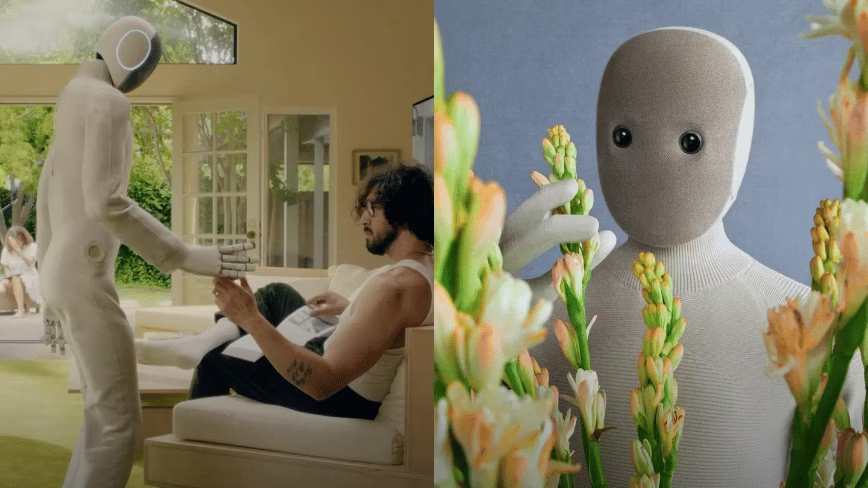
Image: courtesy of Thenextweb
1X's NEO Robot Hands Are A Step Towards Solving Home Robotics' Hardest Problem: Dexterity
Norwegian robotics company 1X has introduced advanced new hands for its NEO humanoid robot, aiming to overcome a significant hurdle in making home robots truly useful. These hands feature 25 degrees of freedom, tendon-driven actuation, high-resolution tactile sensing, and IP68 water resistance. The development suggests a focused effort to move beyond basic locomotion, allowing robots like NEO to perform complex, delicate household tasks such as cooking, cleaning, and handling fragile items with human-like precision.
Outlook
Background
The NEO humanoid robot, from the Norwegian company 1X, made its debut earlier in 2026, launching with a price tag of $20,000. The robot was positioned as the 'world’s first consumer-ready humanoid robot,' designed to automate daily chores and offer personalized assistance. The most recent development, unveiled on July 10, 2026, is a set of highly advanced hands for NEO. Each hand is engineered with 25 degrees of freedom, a measure of how many independent ways a joint or component can move. This level of articulation is crucial for mimicking human dexterity.
These new hands employ a tendon-driven actuation system, which means they use a series of cables and motors to control finger movements, much like tendons in a biological hand. They are also equipped with high-resolution tactile sensors that can detect pressure and identify when an object is beginning to slip from its grip. This sensing capability allows the robot to automatically adjust its force, preventing it from dropping or crushing delicate items. Furthermore, the hands boast an IP68 water resistance rating, making them suitable for tasks involving liquids, such as washing dishes or cleaning spills.
Demonstrations have shown NEO performing a range of precise tasks, including picking individual coins out of a wallet, operating a screwdriver, and zipping up clothing. These capabilities are a direct response to the need for a robot that can interact with the physical world in a nuanced way, a capability 1X describes as providing an 'API to the physical world.' John Koetsier, a prominent tech analyst, highlighted the new hands on July 9, 2026, calling them a 'massive leap toward truly useful humanoid robots,' particularly noting their force feedback and near-human dexterity.
Precedents
The history of robotics is replete with examples of machines mastering specific, repetitive tasks in controlled environments, most notably in manufacturing. Industrial robots have long excelled at assembly line work, welding, and heavy lifting, where precision, speed, and strength are paramount, but general-purpose manipulation is not. Their 'hands' often consist of simple grippers, suction cups, or specialized tools designed for one type of object.
However, the leap from factory floor to a cluttered, unpredictable home environment introduces a different order of complexity. For decades, researchers have grappled with 'Moravec's Paradox,' which states that high-level reasoning is relatively easy for computers, while low-level sensorimotor skills, like perception and dexterity, are incredibly difficult. A robot learning to walk in a straight line is one challenge; a robot learning to pick up a dropped egg without breaking it, identify a specific spice jar, or fold a towel neatly, is another entirely.
Previous attempts at creating dexterous robotic hands often faced limitations in terms of cost, complexity, durability, and the ability to provide meaningful tactile feedback. Many designs were either too rigid, too slow, or lacked the sensory input required to adapt to variations in object size, shape, and texture. This historical context highlights why the focus on high degrees of freedom, tendon drives, and advanced tactile sensing in 1X's NEO hands represents a significant, and necessary, evolution. It acknowledges that for home robots to be truly useful, they must move beyond mere mobility and gain the capacity for nuanced, human-like interaction with an almost infinite variety of objects and tools designed for human hands.
The introduction of 1X's new dexterous hands for the NEO robot changes the conversation around home robotics. Until now, much of the public's perception of humanoid robots has been shaped by their ability to walk, balance, or perform choreographed movements. While impressive, these feats of locomotion, by themselves, do not translate directly into practical utility within a home.
The real value proposition for a home robot lies in its ability to interact with and modify its environment. This means opening doors, picking up items, operating appliances, and handling delicate objects without causing damage. Without highly articulated and sensitive hands, a robot is largely limited to observing or bumping into things. The new NEO hands, with their 25 degrees of freedom and advanced tactile feedback, aim to unlock this crucial 'interaction layer.' This is not just a technical upgrade; it's a fundamental shift towards making the robot a truly functional assistant rather than just a mobile platform.
Furthermore, the design of the hands also addresses a subtle but important psychological aspect. As one unnamed expert noted, rigid, non-human-like hands can contribute to the 'uncanny valley' effect, making robots feel alien and uncomfortable in personal spaces. Hands that more closely resemble and function like human hands could foster greater acceptance and trust from users, making the idea of a robot butler or companion less jarring. By tackling the complex problem of manipulation, 1X is not just improving a robot; it is attempting to enable a new category of consumer technology that promises to redefine how people manage their households and interact with automation.
Scenarios
AnalysisThe development of 1X's new hands for the NEO robot could lead to several distinct outcomes, each with its own set of implications for the home robotics market and broader consumer technology landscape.
Outcome 1: Accelerated Adoption and Market Leadership in Dexterity
One possible outcome is that 1X's NEO robot, powered by these advanced hands, establishes a significant lead in practical home utility. If the hands prove robust, reliable, and capable of consistently performing a wide array of household tasks, 1X could accelerate consumer adoption of humanoid robots. This could position 1X as a frontrunner in the nascent but rapidly growing market for domestic robotics, potentially attracting substantial investment and partnerships. The ability to genuinely handle delicate items, use common tools, and adapt to the unpredictable nature of a home environment would be a compelling differentiator, pushing other manufacturers to rapidly improve their own manipulation capabilities.
Outcome 2: A Niche Technology, Driving Industry Standards
Another scenario is that while the technology itself is highly advanced and impressive, the NEO robot, priced at $20,000, remains a relatively niche product in the short to medium term. The cost, combined with the complexities of integrating such advanced hardware with equally sophisticated AI for task planning and execution, might limit its immediate mass-market appeal. However, even if mass adoption is slow, these hands could become a benchmark for dexterous manipulation in robotics. Other companies might license the technology or be forced to develop comparable solutions, effectively raising the bar for what a 'useful' home robot must be capable of. This would still be a win for 1X in terms of intellectual property and industry influence, even if direct sales volumes are constrained.
Outcome 3: Technical Prowess Outpaces Practical Integration
It is also possible that despite the technical brilliance of the new hands, the overall integration of the NEO robot into a fully autonomous and user-friendly home assistant faces other significant hurdles. The challenge of a home robot is not just its physical capabilities but also its ability to understand complex commands, navigate dynamic environments, learn from human interaction, and handle unexpected situations with grace. If the AI, safety protocols, energy efficiency, or overall reliability do not keep pace with the hand's dexterity, the robot's practical utility could still be limited. In this outcome, the advanced hands might be seen as a crucial component, but one that is still awaiting other breakthroughs in artificial intelligence and systems integration to truly shine in a consumer context. Competitors might also quickly replicate or surpass the hand technology, diluting 1X's initial advantage before widespread market penetration occurs.
Timeline
Frequently Asked Questions
Discussion
Be the first to share your thoughts.