
Expect Gritt to focus on refining its robotic systems and expanding pilot programs on solar farm construction sites. The company will likely concentrate on demonstrating the claimed efficiency gains and reliability in diverse real-world conditions. A key challenge will be scaling manufacturing and deployment while navigating the complexities of construction logistics and workforce integration. We could also see Gritt expanding its robotic applications to other forms of large-scale infrastructure construction beyond solar farms, leveraging the 'bolt-on' nature of its technology.
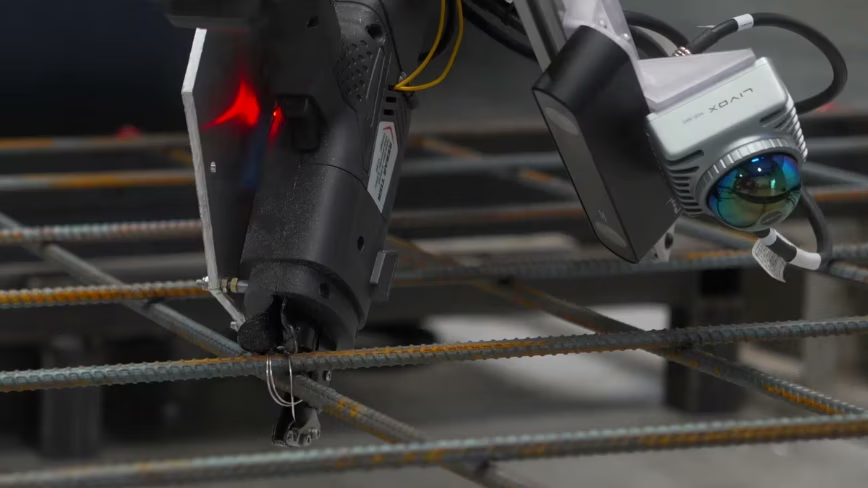
Image: courtesy of Thenextweb
The Unseen Shift: How Gritt's AI Robots Could Remake Solar Farm Building
Gritt, a San Francisco-based startup, secured just over $32 million in combined pre-seed and Series A funding, with Obvious Ventures leading the $26 million Series A round. The company is developing AI-powered robotic systems designed to attach to existing construction equipment, such as skid steers and forklifts. These robots are engineered to automate labor-intensive tasks on large-scale construction sites, particularly solar farms, with claims of installing panels up to four times faster than traditional manual crews. The funding aims to accelerate the deployment of this technology, addressing efficiency challenges and labor shortages within the renewable energy infrastructure sector.
Outlook
Background
The construction industry has historically been slower to adopt automation compared to sectors like manufacturing. It relies heavily on manual labor, which faces increasing shortages globally, particularly in specialized fields like renewable energy installation. The push for faster and cheaper solar farm deployment is intense, driven by climate goals and economic incentives. Existing construction robotics often involves entirely new, purpose-built heavy machinery, which can be expensive and require significant capital investment. Gritt's approach of integrating AI-powered robotic arms with existing equipment represents a different strategy, potentially lowering the barrier to entry for contractors already owning fleets of conventional machinery. This capital-efficient model could accelerate adoption in an industry wary of high upfront costs. The funding round itself, led by Obvious Ventures, a firm focused on sustainable solutions, signals strong investor confidence in the intersection of AI, robotics, and renewable energy infrastructure.
Precedents
The idea of augmenting human labor with machinery is not new; it defines much of industrial history. What is new is the application of advanced AI and robotics to tasks previously considered too complex or variable for automation, especially in unstructured outdoor environments like construction sites. Historically, successful automation in construction has often started with repetitive, high-volume tasks. Early examples include automated road pavers or tunnel boring machines. However, the 'bolt-on' approach echoes earlier industrial revolutions where new power sources (like steam or electricity) were integrated into existing tools and factories rather than requiring entirely new infrastructure. For example, early electric motors were often retrofitted to drive existing mechanical systems. This incremental, less disruptive path to automation has often proven more effective for widespread adoption in traditional industries. Venture capital flows into construction technology ('ConTech') have steadily increased over the past decade, driven by the sector's persistent productivity challenges and the urgent need for infrastructure development. Companies like Boston Dynamics (known for its quadruped robots) have explored construction applications, but few have focused specifically on the 'retrofit' model for solar installation. The pattern suggests that solutions that reduce capital expenditure and leverage existing assets often find a more receptive market among established players.
Gritt's funding and its distinct technological approach carry significant implications for the future of renewable energy infrastructure and the broader construction sector. By developing AI robots that attach to existing equipment, Gritt is not just offering a new tool; it is proposing a different model for automation adoption. This approach could drastically reduce the capital expenditure required for contractors to integrate robotics, making advanced automation accessible to a wider range of businesses, not just those with deep pockets.
The potential to install solar panels up to four times faster directly translates into accelerated project timelines and reduced labor costs. For the solar industry, this means quicker deployment of new energy capacity, which is critical for meeting ambitious climate targets and driving down the levelized cost of solar power. Faster construction cycles free up capital sooner and enable developers to take on more projects, potentially spurring a new wave of solar farm development globally.
Beyond efficiency, the technology could also address persistent labor shortages in construction. Rather than fully replacing workers, these robots are designed to handle the most repetitive and physically demanding tasks, allowing skilled human labor to focus on more complex supervision, quality control, and problem-solving roles. This redefinition of roles could make construction jobs safer and more appealing, potentially attracting new talent to the industry. However, it also raises questions about retraining and the future skill sets required for a robot-augmented workforce.
Ultimately, Gritt's success could serve as a blueprint for how other traditional industries can integrate advanced AI and robotics without a complete overhaul of their existing asset base, offering a path to modernization that is both economically viable and operationally practical.
Scenarios
AnalysisOne clear outcome is that Gritt's technology could significantly accelerate the global deployment of solar energy. If the robots can consistently deliver on their promise of installing panels up to four times faster, it would directly translate into faster project completion times and lower labor costs for solar farm developers. This would make solar power even more competitive against traditional energy sources and could help countries meet renewable energy targets more quickly. The 'bolt-on' nature of the technology means that existing construction companies, rather than needing to invest in entirely new fleets of specialized robotic equipment, could upgrade their current machinery, potentially speeding up adoption across the industry. This could lead to a surge in solar farm construction, particularly in regions facing significant labor constraints or tight project deadlines.
A second, more nuanced outcome involves the evolution of the construction workforce. While the robots automate repetitive tasks, they are unlikely to eliminate human roles entirely. Instead, there could be a shift towards new types of jobs focused on operating, maintaining, and supervising these AI systems. This would necessitate new training programs and skill development initiatives within the construction sector, requiring workers to adapt to a more technology-driven environment. Companies that embrace this transition early could gain a competitive advantage in attracting skilled talent. Conversely, construction firms that are slow to adopt such technologies might find themselves struggling with higher costs, slower project delivery, and difficulties competing for both contracts and skilled labor in a rapidly evolving market.
Timeline
2026-07-21
Gritt Announces $32M Funding Round
San Francisco-based Gritt exits stealth mode, announcing it has secured just over $32 million in combined pre-seed and Series A funding. The Series A round, totaling $26 million, was led by Obvious Ventures, with participation from Union Square Ventures and Active Impact Investments. Existing investors include First Round Capital and Climactic.
2026-07-21
Unveiling of AI-Powered Robotic Systems
Gritt details its core technology: AI robots designed to attach to existing construction equipment like skid steers and forklifts. These systems aim to automate labor-intensive tasks, specifically focusing on placing solar panels up to four times faster than manual crews on large-scale solar farm construction sites.
Frequently Asked Questions
Gritt is developing AI-powered robotic systems that are designed to bolt onto existing construction equipment, such as skid steers and forklifts. These are not entirely new machines, but rather intelligent robotic arms and systems that augment conventional equipment.
Discussion
Be the first to share your thoughts.