
Veridact
TechSportsFinanceGaming🎯 Predictions⭐ OpportunitiesAbout
Sign InSign Up
Veridact

Analysis before the headline. Veridact examines technology, finance, sports, and gaming events before they unfold through forecasting, probability modeling, historical precedent, and public prediction tracking.

Stay ahead of what's next

Forecasts, analysis, and prediction updates delivered to your inbox.

Coverage

  • Tech
  • Sports
  • Finance
  • Gaming

Company

  • About Us
  • Privacy Policy

© 2026 Veridact. Forecasting & analysis platform.

Content may include AI-assisted research and analysis. Predictions and opinions should not be considered financial, legal, medical, or investment advice.

tech
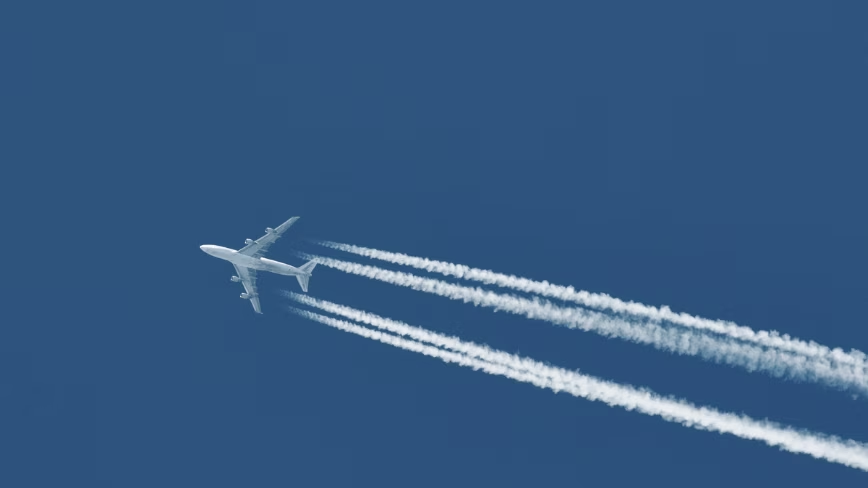
Google and the UK will steer planes around contrails over the Atlantic

Image: courtesy of Thenextweb

techAugust 19, 2026By Veridact EditorialUpdated Aug 19

Google's AI Contrail Trial: Weighing the Costs of Cleaner Skies Over the Atlantic

Google and the UK government have initiated a 30-month trial, 'Operation Blue Skies,' using artificial intelligence to predict and avoid climate-warming contrails over the North Atlantic. Starting in November 2026, the project will guide aircraft to adjust altitudes by up to 2,000 feet within Shanwick airspace, aiming to reduce aviation's climate impact, with an expected cost of £5 million.

Outlook

Beginning in November 2026, the North Atlantic's Shanwick airspace, which covers the eastern half of this busy corridor, will become a live laboratory for climate aviation. Air traffic controllers there will receive real-time, AI-generated forecasts from Google, predicting where atmospheric conditions are ripe for contrail formation. Based on these predictions, controllers will advise pilots to make small altitude adjustments, typically up to 2,000 feet, to bypass these zones.

The trial, confirmed by Google and the UK government, is set to run for 30 months, specifically targeting two winter periods when contrail formation is more prevalent. This duration is crucial for gathering comprehensive data across varying weather patterns and air traffic volumes. The focus remains on altitude changes rather than extensive rerouting, a deliberate choice to minimize potential disruptions to flight schedules and overall fuel burn. Aviation minister Keir Mather publicly stated the partnership's intent to identify practical, actionable methods for making air travel cleaner. This initial phase is designed not just to test the technology, but to validate Google's sophisticated AI models in the complex, dynamic environment of live air traffic operations, ensuring that theoretical predictions translate into tangible, real-world climate benefits with minimal operational friction.

Pilots and airlines participating will need to integrate these advisories into their flight planning and execution, a process that will be closely monitored. The project's success hinges on whether these minor adjustments can significantly reduce contrail persistence without imposing undue burdens on air traffic control, increasing pilot workload, or substantially raising operational costs for carriers. The £5 million investment reflects the scale of this ambition, signalling a serious commitment from both public and private sectors to explore this specific pathway to aviation decarbonization.

Background

Contrails, the white streaks often seen trailing behind jet aircraft at high altitudes, are more than just aesthetically pleasing patterns in the sky. They are, in essence, man-made clouds formed when hot, humid exhaust from jet engines mixes with cold, low-pressure air, causing water vapor to condense and freeze into ice crystals. These ice clouds, particularly persistent ones, can trap heat radiating from Earth, acting like a blanket and contributing significantly to global warming. Scientists estimate that the warming effect of contrails, while transient, can sometimes surpass the climate impact of the carbon dioxide emissions from the burnt fuel itself over certain periods.

This makes contrails a critical, yet often overlooked, component of aviation's overall climate footprint. Unlike CO2, which persists in the atmosphere for centuries, contrails typically dissipate within hours. However, their immediate radiative forcing—the measure of how much energy they add to or subtract from the Earth's climate system—can be substantial. The challenge lies in their unpredictable nature; contrails only form under specific atmospheric conditions, including temperature, humidity, and air pressure, which can vary widely across even short distances and timeframes. This inherent variability is why a solution requires highly accurate, real-time predictive capabilities.

Avoiding contrails does not mean avoiding flying. Instead, it involves minor adjustments to flight paths or altitudes to steer clear of the narrow atmospheric layers where contrails are most likely to form and persist. This strategy offers a distinct advantage over other decarbonization efforts, such as the development of sustainable aviation fuels or electric aircraft, which require wholesale technological overhauls and massive infrastructure investments. Contrail avoidance, if proven effective and scalable, offers a relatively immediate pathway to climate impact reduction using existing aircraft and air traffic control systems, requiring primarily advanced data analytics and operational coordination.

See also

We tried Google’s AI glasses and they’re almost there→

Precedents

For decades, the aviation industry's primary focus in addressing its climate impact has centered on reducing carbon dioxide emissions. This has largely involved incremental improvements in aircraft fuel efficiency, the development and deployment of sustainable aviation fuels (SAFs), and participation in carbon offsetting schemes. While these efforts are crucial for long-term decarbonization, they often involve significant capital expenditure, technological breakthroughs, or complex supply chain reconfigurations.

Contrail mitigation, by contrast, has historically been a more nascent area of research, largely confined to academic studies and smaller, privately funded experiments. The concept of dynamically altering flight paths to avoid contrail formation has been discussed for years, but the practical hurdles were considerable. These included the lack of sufficiently accurate predictive models for atmospheric conditions, the operational complexities of real-time flight adjustments across vast airspaces, and the potential for increased fuel burn if rerouting proved inefficient.

However, advancements in artificial intelligence, satellite observation, and atmospheric modeling have dramatically improved the feasibility of contrail prediction. Early studies, often conducted by research institutions or individual airlines in limited airspace, have indicated that even small changes in altitude can significantly reduce contrail formation, sometimes by as much as 60-80% in specific areas. These smaller-scale proofs of concept have laid the groundwork for a more ambitious, large-scale deployment. 'Operation Blue Skies' distinguishes itself as the first state-backed initiative to tackle contrail avoidance across an entire oceanic airspace, moving beyond theoretical models and isolated tests to integrate this strategy directly into a major air traffic control operation. This institutional step signals a growing recognition that non-CO2 effects of aviation, like contrails, represent a significant, addressable component of the industry's climate challenge.

This trial represents a pivotal moment for aviation's climate strategy, moving beyond the long-standing focus solely on carbon emissions to directly address the immediate warming impact of contrails. If 'Operation Blue Skies' proves successful, it could fundamentally alter how the industry approaches its environmental responsibilities, offering a practical, relatively near-term solution that complements longer-term decarbonization efforts.

The real stakes here extend beyond just reducing white streaks in the sky. It's about demonstrating that intelligent, data-driven operational changes can yield significant climate benefits without demanding revolutionary new aircraft or prohibitively expensive infrastructure overhauls. For airlines, the prospect of mitigating a substantial portion of their climate footprint through relatively minor operational adjustments—provided fuel burn increases are minimal—could be a compelling proposition. It offers a pathway to bolster their environmental credentials and meet evolving regulatory and public expectations for greener travel.

For air traffic control organizations globally, this trial serves as a crucial test of integrating advanced AI decision-support systems into highly safety-critical operations. The success of this integration could pave the way for other AI-driven optimizations, from traffic flow management to adverse weather avoidance, reshaping the future of airspace management. Furthermore, Google's direct involvement places a major technology company at the forefront of a complex climate challenge, showcasing the potential for cross-sector collaboration in tackling global environmental issues. The learnings from the North Atlantic could establish a new operational standard, influencing policy and practice across other major flight corridors and potentially accelerating the adoption of similar climate-conscious flight management strategies worldwide. The tension between climate benefits and operational costs, particularly fuel burn, will be the central metric determining the project's true long-term value and scalability.

Scenarios

Analysis

1. Wider Adoption and Standardisation: If 'Operation Blue Skies' demonstrates a clear and verifiable reduction in contrail formation with minimal increases in fuel consumption or operational delays, the UK government and Google would have a strong case for advocating its wider adoption. This could lead to the phased implementation of similar AI-driven contrail avoidance protocols across other major oceanic and continental airspaces globally. International aviation bodies, such as the International Civil Aviation Organization (ICAO), might then work towards establishing common standards and recommended practices, potentially making contrail avoidance a routine aspect of flight planning and air traffic control. Airlines might face increasing pressure, or even regulatory mandates, to integrate these practices, driving further investment in predictive technologies and operational adjustments. This outcome would mark a significant shift in aviation's climate strategy, adding a crucial, immediate-impact lever to complement longer-term decarbonization goals.

2. Limited Efficacy or Unacceptable Trade-offs: The trial may reveal that while technically feasible, the practical benefits are outweighed by the operational costs. Even small altitude adjustments, if required frequently or across a large number of flights, could collectively lead to a noticeable increase in fuel burn and, consequently, higher CO2 emissions. If the climate benefit from contrail avoidance is significantly offset by increased CO2, the overall environmental gain might be marginal or even negative. This scenario could lead to a re-evaluation of contrail avoidance as a primary climate solution, potentially shifting focus back to other strategies like accelerated sustainable aviation fuel development or electric propulsion. It could also highlight the limitations of current AI models in predicting atmospheric conditions with the precision needed for truly optimal, cost-effective routing, suggesting that further scientific and technological advancements are necessary before widespread deployment.

3. Selective Implementation and Ongoing Refinement: A middle ground could emerge where contrail avoidance is not universally adopted but implemented selectively. For example, it might be applied only during specific atmospheric conditions known to be highly conducive to persistent contrail formation, or in particular high-impact air corridors. Airlines might also integrate contrail avoidance as an optional, financially incentivized operational choice, balancing it against other factors like fuel cost, schedule adherence, and carbon pricing mechanisms. This approach would allow for gradual adaptation and continuous refinement of the AI models and operational procedures, ensuring that the benefits consistently outweigh the costs. It would also foster a more flexible, data-driven approach to environmental management in aviation, allowing for dynamic responses to evolving climate science and operational realities.

Timeline

2026-08-18
Operation Blue Skies Announced
Google officially announced 'Operation Blue Skies,' a collaborative trial with the UK government to use AI for contrail avoidance over the North Atlantic.
2026-11-01
Trial Commencement
The 30-month trial is scheduled to begin, with air traffic controllers in Shanwick airspace starting to use AI-generated forecasts to guide aircraft around contrail-forming regions.
2028-12-31
Expected Trial Conclusion
The 'Operation Blue Skies' trial is expected to conclude, having gathered data over two winter periods, providing comprehensive insights into the efficacy and operational impact of AI-driven contrail avoidance.

Frequently Asked Questions

Contrails are the white lines aircraft leave in the sky, formed by condensed water vapor and exhaust. They are a climate concern because they act like artificial clouds, trapping heat in the atmosphere and contributing to global warming. Scientists suggest their warming effect can be more significant than the carbon dioxide emitted by the aircraft itself over certain periods.

Discussion

0/100
0/1000

Be the first to share your thoughts.

Related Coverage

tech

JPMorgan's $5 Billion Bet on Volta: The Shifting Economics of AI Infrastructure

Aug 28
tech

The Unsleeping AI: What OpenAI's Persistent Agent Means for Control and Capability

Aug 28
tech

The UK's Power Grid Is Overwhelmed by 'Phantom' Data Centers. What This Means for AI Ambitions

Aug 28
tech

Google Engineer's 'Gambling' Defense Tests Legal Limits of Prediction Markets

Aug 28

Stay ahead of the story

AI analysis delivered before events unfold. No spam.

ⓘ

Methodology: Veridact combines public data, historical precedent, and analytical models to evaluate the likelihood of future outcomes.