
The current market dynamic, where tech companies are aggressively seeking diverse data sets to fuel AI development, suggests that deals similar to the Spirit Airlines acquisition will become more frequent. We can expect increased scrutiny, both from privacy advocates and potentially regulators, on the terms of these data sales, particularly concerning the methods and oversight of data anonymization. Companies holding large internal data sets, especially those facing financial distress, may find new value in their archives, potentially leading to a more formalized market for corporate data, complete with new standards for valuation and privacy safeguards. The industry could see the emergence of independent audit firms specializing in data anonymization, or perhaps new regulatory guidelines mandating third-party, arms-length processing.
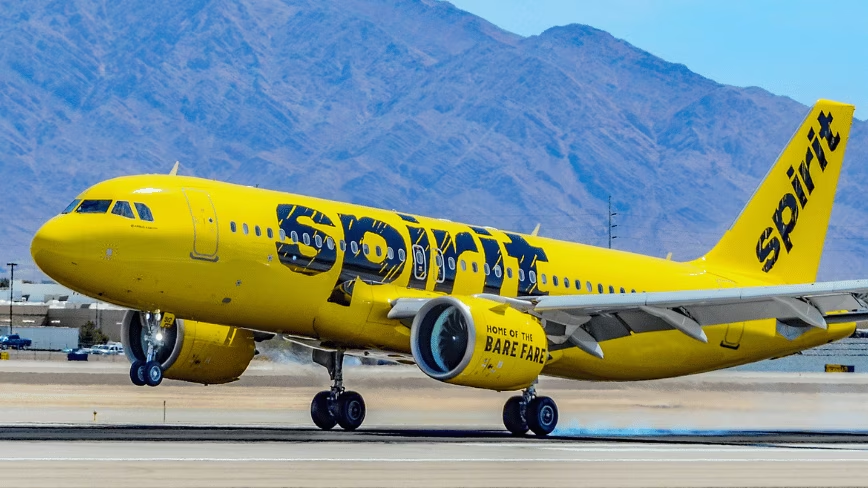
Image: courtesy of Thenextweb
Google Paid for Spirit Airlines Data Anonymization: What That Means for AI Privacy
Google acquired a substantial trove of internal operational and customer data from the bankrupt Spirit Airlines for $10 million. While the deal specifies the data must be anonymized to protect individual privacy, a critical detail in the sale agreement reveals Google itself picked and paid for the firm responsible for this anonymization. This arrangement raises questions about the independence and rigor of the data scrubbing process, setting a precedent for how valuable corporate data is handled as tech giants increasingly look beyond the public internet to train their artificial intelligence models.
Outlook
Background
The auction for Spirit Airlines' data, which concluded with Google's $10 million bid, was competitive, indicating the high demand for such information. Google initially offered $5 million, but faced a counter-offer of $5.2 million from AI data firm Mercor. Mercor then raised its offer to $7 million, contingent on taking the raw data first and performing the anonymization itself. Google ultimately secured the deal at $10 million, with Mercor remaining as a backup buyer at $7.5 million. This aggressive bidding highlights a broader industry trend: tech companies, having largely exhausted publicly available internet data, are now seeking more specialized, internal corporate data to refine their AI models. Such data can be particularly valuable for training AI to handle complex tasks like customer service inquiries, debugging software, or optimizing logistical operations. For example, AI training startup Micro1 has a program that pays midsize companies between $100,000 and $2 million for access to their anonymized data, illustrating the market value of these internal records.
See also
Precedents
The current scramble for proprietary data echoes earlier phases of the internet economy, where companies like Google and Facebook built empires by aggregating vast amounts of user data, often from publicly accessible sources or through broad terms of service agreements. What differs now is the explicit financial transaction for internal, operational datasets, and the specific application towards AI model training. This move away from open-source or passively collected data towards direct corporate data acquisition represents a maturation of the data market. Historically, public concern over data privacy has often lagged behind technological advancements, leading to reactive regulation. The sale of company assets during bankruptcy proceedings also has a long history, but the nature of 'data' as an asset, particularly when intended for AI, introduces novel privacy considerations that traditional asset sales did not. The fact that Spirit Airlines' internal communications, spreadsheets, and transaction records were on the block, even without direct personal identifiers, points to a new frontier in asset valuation and disposal.
The detail that Google, as the buyer, both designated and paid for the firm responsible for anonymizing Spirit Airlines' data is not a minor footnote. It introduces a potential conflict of interest that could undermine public trust in data anonymization processes. When the entity benefiting from the data also controls the scrubbing process, questions naturally arise about the thoroughness and independence of that scrub. The sale agreement did stipulate that the process must 'preserve referential integrity across the data set,' a technical requirement that ensures the data remains useful for training AI while theoretically removing personal identifiers. However, the integrity of this process is paramount for privacy. This transaction sets a critical precedent for future corporate data sales, especially as more companies, particularly those in financial distress, may consider monetizing their internal datasets. It forces a conversation about who should oversee data anonymization, and whether third-party, truly independent oversight should become a standard requirement in such high-stakes deals to maintain public confidence and protect individual privacy. For consumers, while their direct personal profiles and loyalty program details were excluded from this specific Spirit Airlines deal, the broader trend of corporate data acquisition for AI means the operational data surrounding their interactions with companies is increasingly valuable, even when 'anonymized.'
Scenarios
AnalysisOne possible outcome is that the specifics of this deal may galvanize privacy advocates and consumer protection groups to push for stricter regulatory oversight on AI data acquisition. This could lead to new guidelines or laws mandating independent third-party anonymization for sensitive corporate data sales, especially when the buyer has a vested interest.
Another scenario is that tech companies, in a bid to pre-empt regulation and maintain public trust, may proactively adopt industry best practices for data anonymization. This could involve establishing a consortium to certify anonymization firms or creating transparent standards for data scrubbing, potentially moving towards a model where anonymization is performed by a neutral, accredited entity rather than a firm chosen by the buyer.
A third possibility is that the market for corporate data will become increasingly sophisticated. Companies may begin to invest more heavily in their own internal data governance and anonymization capabilities, making their datasets more attractive to buyers and commanding higher prices. This could also lead to a clearer distinction between different tiers of 'anonymized' data, with varying levels of privacy assurances and corresponding valuations.
However, there is also the risk that without robust external checks, the current model of buyer-controlled anonymization could become normalized. This might lead to a perception, or even a reality, of less stringent data protection, potentially increasing the long-term risk of data re-identification as AI and computational power advance, even if those risks are considered low today.
Timeline
Frequently Asked Questions
Discussion
Be the first to share your thoughts.