
This partnership signals a serious intent from Google to move beyond foundational AI research into practical, creative applications within a specific industry. Expect A24 filmmakers to act as early adopters and testers, providing feedback that shapes the development of these new AI tools. The non-exclusive nature of the deal suggests that any technologies developed could eventually be offered more broadly to the film industry, potentially through Google Cloud or other platforms. The immediate focus will likely be on tools that assist with pre-production (e.g., script analysis, visual development), production (e.g., virtual production, advanced editing), and post-production (e.g., visual effects, sound design) without replacing human creative roles entirely.
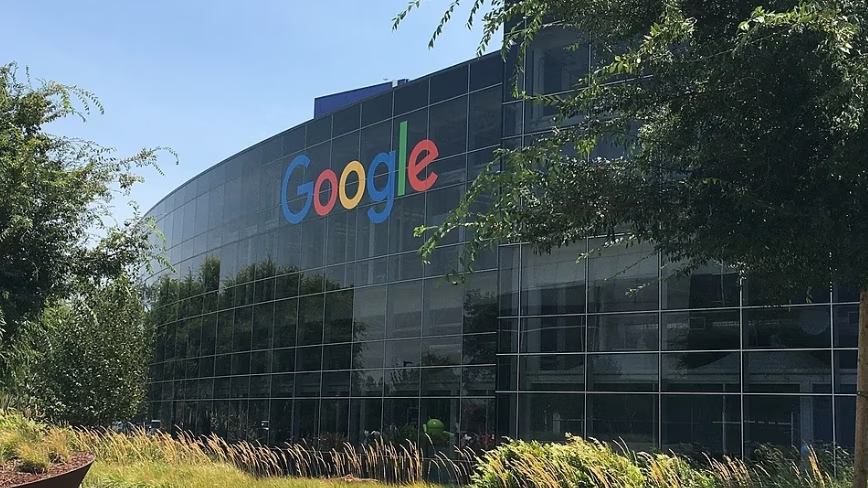
Image: courtesy of Thenextweb
Google DeepMind Bets $75 Million on A24 to Reshape Filmmaking with AI
Google has invested $75 million in independent film studio A24, marking its first direct stake in a movie production company. The deal establishes a multiyear research partnership between A24 and Google's DeepMind unit, focused on developing new AI-powered tools and workflows for filmmakers. Crucially, the agreement explicitly states that Google will not gain access to A24's extensive content library or proprietary data, signaling a focus on creative collaboration rather than content acquisition.
Outlook
Background
The $75 million investment aligns with a previous capital injection from Thrive Capital into A24, suggesting a valuation benchmark for the studio. For Google, this move extends its reach into the entertainment sector, but with a distinct focus on underlying technology rather than direct content ownership, a different strategy from rivals like Amazon or Apple. DeepMind, known for its advanced AI research, including achievements in areas like AlphaGo and protein folding, is now turning its considerable resources towards the notoriously complex and creatively driven world of film. A24, meanwhile, has built a reputation for artist-driven, critically acclaimed films, making it an interesting choice for a tech giant seeking to integrate AI into creative processes without alienating the artistic community. The explicit exclusion of A24's content library from Google's access is a significant detail, addressing potential concerns about data exploitation or creative control often raised when tech companies enter media partnerships.
See also
Precedents
Tech giants have a long, often complicated, history with Hollywood. Companies like Netflix, Amazon, and Apple have poured billions into content production and acquisition, aiming to dominate streaming and media consumption. Google itself has YouTube, a vast content platform, and has experimented with original programming through YouTube Premium. However, this A24 deal represents a different approach: an investment in enabling technology for filmmaking, rather than solely acquiring finished films or series. Historically, technological advancements, from sound to color to digital cameras and CGI, have always reshaped the film industry. The introduction of AI tools could be seen as the next major wave, following a similar pattern of new technology offering new creative possibilities and operational efficiencies. The challenge, as always, will be to introduce these tools in a way that empowers artists rather than replaces them, a lesson learned from previous technological shifts where initial resistance often gave way to integration.
This partnership is not just another tech investment; it signals a critical juncture for both AI and the film industry. For AI development, it represents a high-profile application in a domain traditionally seen as uniquely human and creatively driven. Success here could validate AI's potential in complex artistic fields, pushing its capabilities beyond purely analytical or logistical tasks. For Hollywood, it raises fundamental questions about the future of creative workflows, intellectual property, and the very definition of 'filmmaking.' If DeepMind and A24 successfully develop tools that enhance storytelling and production efficiency, it could set a new industry standard. Conversely, if the tools are perceived as stifling creativity or automating jobs, it could spark significant backlash. This collaboration could redefine the relationship between technology and art, potentially leading to new genres, faster production cycles, or entirely new forms of visual media. It also highlights A24's strategic positioning, leveraging its artistic credibility to influence the development of future creative technologies rather than simply being a recipient of them.
Scenarios
AnalysisOne immediate outcome could be the emergence of specialized AI tools that streamline specific, labor-intensive aspects of filmmaking, such as generating initial storyboards, refining visual effects, or automating certain editing tasks. This could lead to faster production times and potentially lower costs for certain types of films.
Another possibility is that the partnership yields entirely new creative workflows that integrate AI as a co-creator or assistant, allowing filmmakers to explore visual and narrative possibilities that were previously too complex or time-consuming. This could push the boundaries of cinematic storytelling, enabling more ambitious and visually intricate projects.
However, there is also the potential for skepticism and resistance within the broader creative community. If the AI tools are seen as encroaching on human artistry or threatening jobs, their adoption could be slow or met with significant opposition. This could force A24 and Google to carefully calibrate their messaging and demonstrate the clear benefits to creative professionals.
Finally, the non-exclusive nature of the deal and Google's non-access to A24's content library suggests that any successful tools developed could eventually be commercialized and offered to other studios. This could democratize access to advanced AI filmmaking capabilities, potentially leveling the playing field for smaller production houses, but also creating a new competitive dimension based on technological adoption.
Timeline
Frequently Asked Questions
Discussion
Be the first to share your thoughts.