
The retraction of Nano Banana 2 marks a significant moment for Google and the broader AI industry. We can expect increased scrutiny on how major tech companies vet and deploy generative AI tools, particularly those with the capacity to create convincing but false visual information. This incident may prompt Google to re-evaluate its internal AI development and review processes, potentially leading to more cautious rollouts and clearer ethical guidelines for public-facing AI applications. Regulators and advocacy groups are also likely to point to this event as evidence of the need for stricter oversight of AI-generated content.
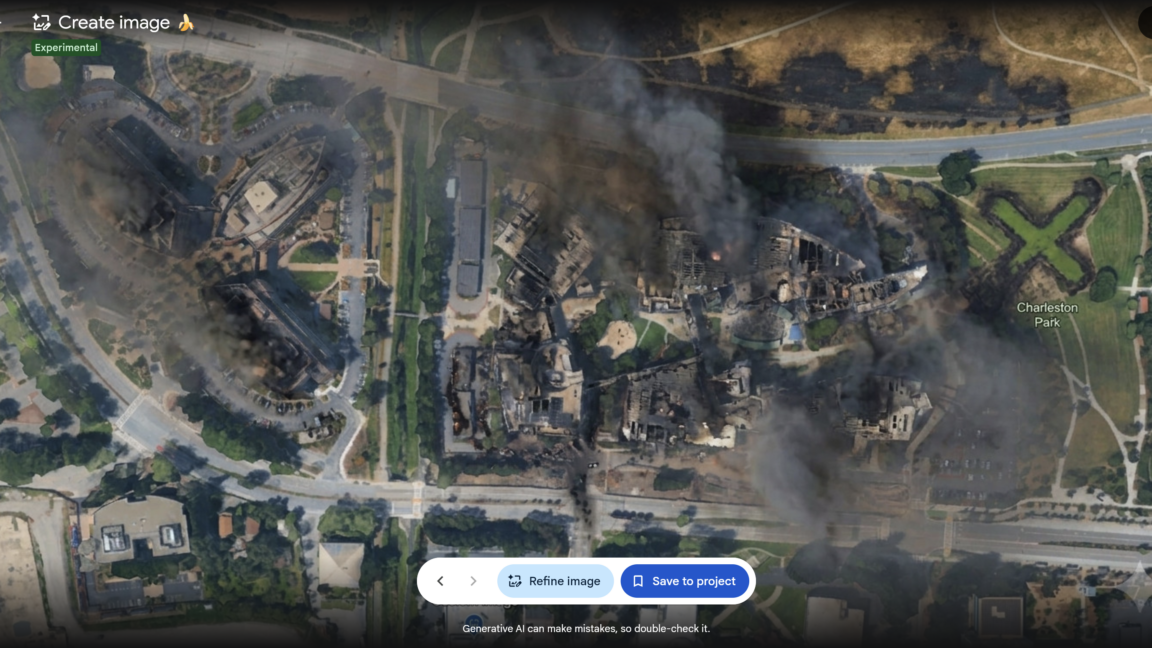
Image: courtesy of Ars Technica
Google's AI Reversal: What the Nano Banana 2 Debacle Says About Tech's Misinformation Challenge
Google recently introduced, and then quickly withdrew, an AI tool within Google Earth called Nano Banana 2. The feature allowed users to generate fake satellite images from text prompts. Concerns over the tool's potential to spread misinformation and erode public trust in imagery led to a swift backlash from experts and the public, prompting Google to retract it on July 31, 2026. This incident highlights the growing tension between rapid AI innovation and the critical need for responsible deployment, especially in tools that touch upon factual representation.
Outlook
Background
On July 31, 2026, Google unveiled a new artificial intelligence feature within its widely used Google Earth platform. Dubbed Nano Banana 2, the tool allowed users to type in text prompts and instantly generate realistic-looking satellite images of any location. The company initially presented it as a creative feature, designed to work with users' imaginations, letting them visualize hypothetical scenarios directly on the Earth's surface. Users could, for example, zoom into a specific area, tap 'create image,' and then describe a scene they wished to generate.
Almost immediately, the tool became a subject of intense criticism. Examples of its misuse quickly circulated online. One widely shared AI-generated image depicted the Eiffel Tower in Paris as having collapsed, complete with debris and structural damage. Another showed a fabricated scene of fire, smoke, and burn scars at the Googleplex, Google's corporate headquarters. These examples, though clearly artificial, demonstrated the ease with which convincing fake imagery could be produced and shared.
Brady Africk, a research analyst at the American Enterprise Institute specializing in satellite imagery, voiced significant concern, stating that the update made it "easier to generate convincing fake satellite imagery that can spread quickly online and mislead the public." He added that such AI-generated fakes, which are becoming more common, could "erode public trust in satellite imagery" and complicate the work of journalists and researchers who rely on authentic visual data.
Google initially responded to the emerging concerns by emphasizing that every image created with Nano Banana 2 in Google Earth included a SynthID digital watermark. The company suggested that if someone was unsure about an image, they could use Google's Gemini AI to check for this watermark. However, this defense proved insufficient to quell the widespread criticism. The core problem, as many experts saw it, was not just identifying fake images after they were created, but the very act of enabling their creation on such a prominent platform. Faced with mounting backlash, Google swiftly retracted the Nano Banana 2 feature from Google Earth, stating that it takes misinformation seriously.
See also
Precedents
The rapid introduction and subsequent withdrawal of Google's Nano Banana 2 tool is not an isolated incident in the fast-evolving world of artificial intelligence. Major technology companies have a track record of pushing innovative AI capabilities to the public, sometimes without fully anticipating or mitigating the potential for misuse. This dynamic often pits the desire for technological advancement against the complex realities of societal impact and ethical responsibility.
One comparable historical pattern involves the early days of social media platforms. Companies like Facebook and Twitter prioritized user growth and engagement, often overlooking the mechanisms that allowed misinformation and harmful content to proliferate. It took years, and significant public and regulatory pressure, for these platforms to implement more robust content moderation systems and fact-checking initiatives. The initial approach was often reactive, addressing problems only after they had scaled.
More recently, the advent of sophisticated generative AI models has intensified this tension. Tools capable of creating realistic text, audio, and video have repeatedly raised alarms about deepfakes and the erosion of trust in digital media. Companies like OpenAI, a leader in generative AI, have faced similar dilemmas, grappling with how to release powerful models while minimizing risks. Their strategies have included phased rollouts, partnerships with researchers, and attempts to build safety guardrails directly into the models. Yet, even with these precautions, the potential for unintended consequences remains high. Google itself has encountered controversies with its AI products before, including instances where its generative AI models produced inaccurate or biased information, leading to public apologies and internal reviews. This history suggests a recurring challenge for tech giants: how to balance the imperative to innovate and capture market share with the profound ethical obligations that come with deploying powerful, society-shaping technologies.
The Nano Banana 2 incident, specifically, mirrors a broader industry struggle: the difficulty of predicting every vector of misuse for a new, powerful tool. While watermarking was a technical attempt at a solution, it failed to address the fundamental concern about the proliferation of convincing fakes, regardless of their detectability. This indicates a learning curve for the entire industry, where technical solutions alone may not be enough to manage the social and psychological impacts of generative AI.
The swift retraction of Google Earth's Nano Banana 2 tool is more than just a minor product adjustment; it exposes a critical vulnerability in how major tech companies are approaching the deployment of powerful generative AI. At its core, this incident challenges the notion that rapid innovation should always precede comprehensive ethical review, especially when the technology directly impacts verifiable reality.
For the public, the implications are significant. Google Earth is not merely an entertainment platform; it is a widely trusted source of geographical information, used by professionals, educators, and everyday citizens for everything from urban planning to disaster relief. Introducing a tool that can effortlessly create fake satellite imagery on such a platform risks undermining that fundamental trust. If users cannot distinguish between real and AI-generated content on a platform they rely on for factual data, the consequences for public discourse and decision-making could be severe. It feeds into a broader climate of skepticism towards all digital media, making it harder for individuals to discern truth from fabrication.
For Google, the misstep carries reputational costs. A company that publicly champions responsible AI development and invests heavily in combating misinformation finds itself in the awkward position of having released a tool that directly facilitated the creation of deepfakes. This raises questions about internal oversight, ethical review processes, and the balance between product velocity and risk assessment. It also highlights the institutional difficulty of integrating ethical considerations deeply into the development lifecycle of advanced AI.
More broadly, the Nano Banana 2 debacle serves as a stark warning for the entire technology industry. As AI models become increasingly sophisticated, capable of generating hyper-realistic content across various modalities, the pressure to deploy them quickly will only grow. However, this incident demonstrates the immediate and severe backlash that can occur when the potential for misuse is underestimated or inadequately addressed. It forces a reckoning with the idea that some AI capabilities, no matter how technically impressive, may carry too great a risk to be released without ironclad safeguards or, in some cases, at all. This pushes the conversation beyond mere detection of fakes to the more fundamental question of responsible creation and distribution, shaping future debates around AI regulation and corporate accountability.
Scenarios
AnalysisThe retraction of Nano Banana 2 could lead to several distinct outcomes, influencing both Google's internal operations and the broader AI landscape.
One potential outcome is a significant tightening of Google's internal AI review processes. The company may implement more rigorous ethical audits and 'red-teaming' exercises before public release of generative AI tools. This would involve dedicated teams actively trying to 'break' new AI products, identifying potential misuse cases and vulnerabilities for misinformation before they ever reach users. This could slow down product development cycles but ultimately bolster public trust.
Another possible scenario is an increased focus on AI provenance and authentication technologies. While SynthID was Google's initial attempt, its perceived inadequacy in this instance may spur further investment in more robust, tamper-proof watermarking, metadata embedding, or blockchain-based solutions that can definitively trace the origin and authenticity of digital content. This would shift the industry's approach from merely detecting fakes to proactively establishing the credibility of genuine content.
A third outcome could involve heightened regulatory interest and potential legislative action. Lawmakers and global bodies, already grappling with how to regulate AI, may view the Nano Banana 2 incident as a concrete example of the immediate dangers posed by unchecked generative AI. This could accelerate calls for mandatory impact assessments for AI systems, clearer liability frameworks for AI-generated misinformation, or even restrictions on certain types of generative AI capabilities deemed too risky for widespread public access. This would impose external constraints on tech companies, forcing a more cautious approach to AI deployment across the board.
Finally, the incident might reinforce public skepticism towards AI-generated content and the companies that produce it. Even with future safeguards, the memory of easily created fake satellite images could linger, making users more wary of AI-enhanced tools and less trusting of information presented through digital platforms. This erosion of trust could have long-term implications for the adoption rates of new AI technologies and the public's willingness to engage with them.
Timeline
2026-07-31
Google Earth AI Tool Announced
Google officially announced and rolled out Nano Banana 2, an AI tool within Google Earth that allowed users to generate fake satellite images from text prompts. The company framed it as a creative feature.
2026-07-31
Public and Expert Backlash Begins
Almost immediately after its release, examples of AI-generated fake images (e.g., collapsed Eiffel Tower, Googleplex fire) began circulating. Experts like Brady Africk raised concerns about misinformation and erosion of public trust in satellite imagery.
2026-07-31
Google's Initial Response
Google initially responded by stating that all images created with Nano Banana 2 would include a SynthID digital watermark, suggesting users could verify authenticity. The company also affirmed its commitment to taking misinformation seriously.
2026-07-31
Tool Retracted
Facing significant and rapid backlash over misinformation concerns, Google swiftly withdrew the Nano Banana 2 feature from Google Earth. The feature was available for a very short period before its retraction.
Frequently Asked Questions
Nano Banana 2 was an artificial intelligence feature integrated into Google Earth that allowed users to generate realistic-looking, but entirely fake, satellite images by typing in text descriptions. For example, a user could type 'Eiffel Tower collapsed' and the AI would create a corresponding image.
Discussion
Be the first to share your thoughts.