
Expect the AI chip market to continue its rapid diversification as startups like Etched carve out specialized niches. The focus will shift increasingly to the commercial rollout and real-world performance of Etched's chips, particularly how they measure up against Nvidia's offerings in terms of efficiency, cost, and raw speed for AI inference workloads. Further funding rounds and strategic partnerships are likely as Etched moves from customer testing to broader market availability, potentially reshaping the competitive dynamics for AI hardware beyond the current training-centric narrative.
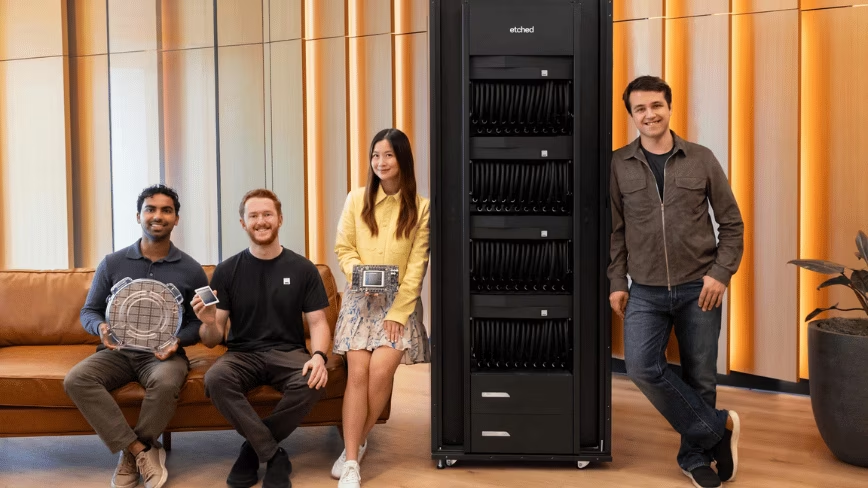
Image: courtesy of Thenextweb
Etched's $10 Billion Inference Bet: How A Startup Plans To Break Nvidia's AI Chip Grip
AI chip startup Etched has more than doubled its valuation to $10.3 billion in just seven months, securing $300 million in Series C funding led by Sequoia Capital. The company, founded in 2022 by three Harvard dropouts, is directly challenging Nvidia by developing custom chips specifically optimized for AI inference, particularly transformer-based models. This surge in valuation reflects intense investor confidence in specialized hardware designed to efficiently run AI models, rather than train them. Etched has already manufactured its first chips at TSMC, has systems in customer testing, and reports $1 billion in customer orders.
Outlook
Background
The AI industry is in a sustained boom, driving unprecedented demand for specialized hardware. Nvidia, primarily known for its powerful GPUs, has largely dominated the market for AI chips, especially for the 'training' phase where large language models (LLMs) learn from vast datasets. However, the subsequent 'inference' phase — where these trained models are actually used to generate text, images, or predictions — represents an equally massive, if less discussed, opportunity.
Etched's strategy is to create highly efficient, custom-designed chips solely for this inference workload. This targeted approach aims to outperform general-purpose GPUs, which, while versatile, may not be as cost-effective or energy-efficient for the specific, repetitive calculations involved in running trained AI models. The company's rapid valuation increase, from $5 billion in December 2025 to $10.3 billion by July 2026, signals a strong belief among investors that this specialized focus holds significant commercial potential.
Key investors like Sequoia, a16z, and memory giant SK Hynix are backing Etched, with the latter's involvement suggesting a strategic interest in the future of AI hardware supply chains. The reported $1 billion in customer orders, even at this early stage of product rollout, indicates substantial demand from companies looking for alternatives to Nvidia's hardware, especially as the operational costs of running AI models continue to climb.
Precedents
The technology industry has a long history of specialized hardware emerging to challenge general-purpose solutions once a market matures. In the early days of computing, general-purpose CPUs handled almost all tasks. Over time, specialized chips like Graphics Processing Units (GPUs) for graphics rendering, and later Application-Specific Integrated Circuits (ASICs) for tasks like Bitcoin mining, proved far more efficient for particular workloads.
Nvidia itself leveraged this pattern, transforming its gaming GPUs into the dominant architecture for AI training by proving their superior parallel processing capabilities compared to traditional CPUs. Now, the cycle appears to be repeating within the AI chip market itself. While Nvidia's GPUs excel at the highly parallelized matrix multiplications required for AI training, the inference stage presents a slightly different set of optimization challenges, particularly around latency and energy efficiency for deployment at scale.
Historically, companies that successfully identify and dominate these specialized niches can achieve significant market share and high valuations, even against established giants. The dot-com era saw massive valuations for companies with unproven products, often followed by a correction. However, the current AI boom is underpinned by tangible technological advancements and commercial demand, distinguishing it from purely speculative bubbles. The involvement of major institutional investors and established industry players like SK Hynix suggests a more grounded, strategic investment, focused on long-term market capture rather than short-term hype. The speed of Etched's valuation growth, doubling in seven months, echoes the intense demand and capital flowing into foundational AI infrastructure, reminiscent of the early internet infrastructure build-out.
Etched's rapid ascent and $10.3 billion valuation are not just another startup success story; they represent a critical inflection point in the broader AI industry. For years, Nvidia has been the undisputed king of AI hardware, largely due to its early lead and ecosystem around GPUs. While its dominance in AI training is likely to continue for some time, Etched's rise signals a serious challenge to its near-monopoly in the equally crucial realm of AI inference.
This matters for several reasons. First, for companies developing and deploying AI models, a viable alternative to Nvidia could mean significant cost savings and greater efficiency. Running large AI models for inference at scale is expensive, both in terms of hardware acquisition and ongoing energy consumption. If Etched can deliver on its promise of more efficient, custom-designed chips, it could lower the barrier for businesses to integrate advanced AI into their operations, accelerating innovation across industries.
Second, the emergence of a strong competitor could foster a more dynamic and competitive AI hardware market. Competition typically drives down prices, spurs innovation, and reduces reliance on a single vendor. This is a welcome development for an industry that has expressed concerns about vendor lock-in and supply chain concentration.
Third, for investors, Etched's valuation validates the strategy of betting on highly specialized AI hardware. It suggests that the market for AI chips is not a winner-take-all scenario, but one with ample room for niche players who can offer superior performance for specific tasks. This could open the floodgates for more startups focusing on diverse aspects of AI acceleration, from edge computing to specific model architectures.
Finally, the involvement of a memory giant like SK Hynix is particularly telling. Memory is a critical component of AI systems, and a strategic investment in a chip designer like Etched suggests SK Hynix is positioning itself for future growth in the AI hardware supply chain, potentially influencing memory designs to better suit specialized AI accelerators.
Scenarios
Analysis1. Etched establishes itself as a significant player in AI inference: If Etched successfully delivers on its promises of superior performance and efficiency for transformer-based AI inference, it could capture a substantial portion of this market. This would lead to sustained growth, potentially attracting further investment and solidifying its position as a credible alternative to Nvidia for specific workloads. The initial $1 billion in customer orders suggests strong demand, but scaling production and validating performance in diverse customer environments will be critical. This outcome would likely drive down the overall cost of AI inference, accelerating the deployment of AI applications.
2. Nvidia adapts and integrates specialized inference solutions: Faced with growing competition from specialized chipmakers like Etched, Nvidia may respond by further optimizing its own GPU architectures for inference, or by acquiring companies that have developed complementary technologies. Nvidia has a history of strategic acquisitions and continuous innovation, and it could leverage its vast resources and established ecosystem to maintain its market leadership, even as the market fragments. This could result in a more diverse product portfolio from Nvidia, offering highly optimized solutions for both training and inference.
3. Etched faces significant execution challenges: Building custom chips, especially at scale, is an extraordinarily complex and capital-intensive undertaking. Etched could encounter unforeseen technical hurdles in manufacturing, software integration, or customer adoption. Despite strong early investor confidence and orders, converting those orders into sustained revenue and market share requires flawless execution, particularly when competing with an incumbent as formidable as Nvidia. Delays, performance issues, or a failure to scale production could temper its growth and valuation.
4. The AI chip market continues to fragment and specialize: Beyond Etched and Nvidia, other startups and established tech giants (like Google with its TPUs or Amazon with Inferentia) are also developing custom AI accelerators. Etched's success could encourage further specialization across the industry, leading to a landscape where different chip architectures dominate specific AI workloads or deployment environments (e.g., cloud, edge, mobile). This could create a highly competitive but fragmented market, where no single player holds a complete monopoly, fostering a robust ecosystem of hardware and software innovation.
Timeline
2022
Etched Founded
Three Harvard dropouts establish Etched, an AI chip startup focused on specialized hardware for AI.
December 2025
Series B Funding and $5 Billion Valuation
Etched raises $500 million in a funding round, achieving a $5 billion valuation.
June 2026
First Chips Manufactured and Customer Testing Begins
Etched successfully manufactures its initial chips at TSMC and begins testing its first full systems with clients.
July 24, 2026
Series C Funding and $10.3 Billion Valuation
Etched announces a $300 million Series C funding round led by Sequoia, doubling its valuation to $10.3 billion in seven months. The company confirms $1 billion in customer orders and reports 400 employees and an 80,000-square-foot facility in Michigan.
Frequently Asked Questions
Etched designs custom chips specifically optimized for AI inference, particularly for transformer-based AI models. Unlike general-purpose GPUs, Etched's hardware is tailored to efficiently run trained AI models, aiming for superior performance and energy efficiency in deployment.
Discussion
Be the first to share your thoughts.