
Businesses, both domestic and international, should anticipate a more complex and stringent regulatory environment for e-commerce operations in China. The draft amendments are expected to lead to increased compliance burdens, particularly around data handling, algorithm transparency, and fair competition practices. For Chinese companies operating or planning to expand overseas, the new framework will likely provide clearer state backing and potentially new mechanisms to navigate foreign tariffs and trade disputes. The public consultation period will likely see input from major e-commerce players, and the final version of the law, once enacted, will set a new baseline for digital commerce in one of the world's largest markets. Enforcement is likely to be robust, building on a pattern of increasing regulatory scrutiny seen in recent years.
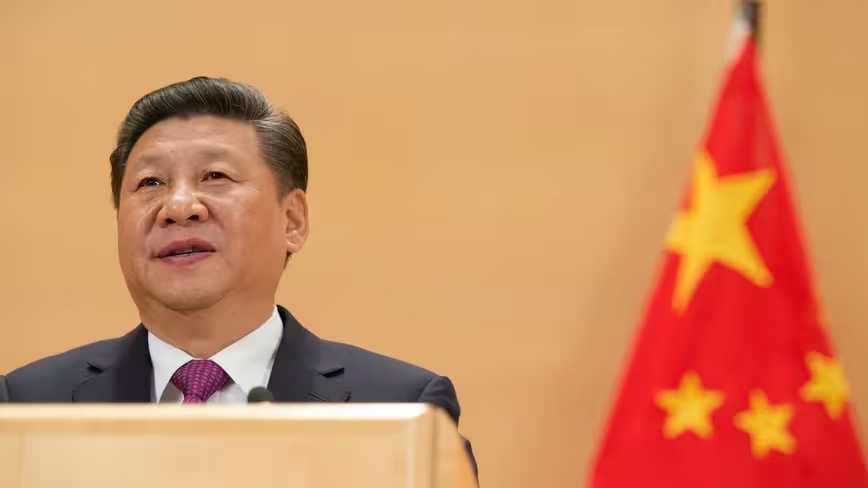
Image: courtesy of Thenextweb
China's Dual Digital Strategy: Tighter E-commerce Rules At Home, Global Shield for Companies Abroad
China has put forward draft amendments to its e-commerce law, aiming to strengthen oversight of digital platforms within the country while simultaneously protecting its companies as they expand into foreign markets. The 20-provision draft, open for public comment until August 4, 2026, represents a strategic move to standardize online and offline commerce regulations, address existing legal gaps, and provide a clearer framework for the digital economy. This initiative is aligned with Beijing's broader economic goals outlined in its 15th Five-Year Plan for 2026-2030, which seeks to both consolidate domestic control over powerful tech firms and bolster their competitiveness against international tariffs and regulatory hurdles.
Outlook
Background
The current e-commerce law, originally enacted in 2019, is no longer considered sufficient by Chinese regulators to keep pace with the rapid growth and evolving complexities of the digital economy. The proposed revisions focus on clearly defining the rights and obligations of market participants, closing existing legal loopholes, and increasing transparency. This move is part of a broader, sustained effort by Beijing to rein in its powerful technology sector, which has grown largely unchecked for years. The amendments are also explicitly designed to support Chinese firms as they face growing protectionism and tariffs in foreign markets, particularly from Western countries. This reflects a strategic pivot towards fostering a resilient domestic digital ecosystem while simultaneously enabling its global expansion, often through state-backed initiatives and legal protections.
See also
Precedents
China has a history of incrementally tightening its regulatory grip on the digital sector. The draft e-commerce amendment follows a series of legislative actions. In June 2025, the Anti-Unfair Competition Law was revised, with the new version becoming effective on October 15, 2025. This revision notably defined platform operators' duties for the first time, establishing them as "gatekeepers" responsible for maintaining a level playing field. Rules that took effect in February 2026 further expanded regulatory oversight. Beyond e-commerce, China has also tightened rules on outbound investment, providing a clearer legal basis for restricting cross-border deals involving sensitive technologies like AI. This consistent pattern indicates a long-term strategy of asserting state control over key economic sectors and strategically positioning Chinese companies for international competition. The 15th Five-Year Plan (2026-2030) provides the broader policy umbrella for these actions, indicating that this is not an isolated initiative but a coordinated part of a larger national development strategy.
This legal revision changes the fundamental operating environment for almost every digital business in China and for Chinese businesses globally. Domestically, it signifies a deeper institutionalization of state control over tech giants, affecting everything from how user data is collected and managed to how algorithms influence consumer behavior. The increased compliance costs and potential for stricter penalties (the 2018 law already outlined fines up to 500,000 RMB for serious violations) could reshape market competition and innovation within China. For international trade, the law's explicit aim to shield Chinese companies abroad could create new friction points. It suggests Beijing is prepared to use its legal framework to counter foreign tariffs and protect its firms, potentially leading to retaliatory measures or further decoupling in global digital trade. Consumers, both in China and abroad, will experience the effects through changes in product availability, data privacy practices, and potentially the cost of goods and services. The move highlights China's ambition to not only regulate its vast digital economy but also to project its regulatory philosophy and economic power on a global scale.
Scenarios
AnalysisOne of the most immediate outcomes for businesses operating in China is an increased compliance burden and potential domestic market consolidation. The new regulations will likely impose significant costs on e-commerce platforms, particularly smaller and medium-sized enterprises (SMEs) that may struggle to adapt to stringent data, algorithm, and fair competition requirements. This could lead to further market consolidation, favoring larger, well-resourced platforms that can more easily absorb these costs and invest in necessary compliance infrastructure. The regulatory clarity, while burdensome, may also reduce some operational ambiguities, potentially fostering a more predictable, albeit tightly controlled, domestic market environment. Enforcement could involve substantial fines and operational restrictions for non-compliant firms.
Simultaneously, the amendments could lead to enhanced global competitiveness for Chinese firms, but also increased trade friction. By explicitly aiming to shield Chinese companies abroad, the new law could empower Beijing to offer more direct legal and diplomatic support to its firms facing foreign tariffs, anti-dumping measures, or market access restrictions. This might involve legal challenges through international bodies or bilateral negotiations. While intended to strengthen Chinese firms' global presence, this approach could also exacerbate existing trade tensions with countries wary of China's state-backed economic model. It may lead to a more fragmented global digital economy, with different regulatory blocs and increased scrutiny of Chinese digital products and services in foreign markets.
A third outcome could be a significant shift in data governance and consumer trust. The focus on data and algorithms in the amendments suggests a move towards a more centralized and controlled data governance framework. This could mean stricter requirements for data localization, cross-border data transfer, and algorithm transparency within China. For consumers, this might translate into stronger data protection in some areas, but also potentially less privacy from state oversight. The long-term impact on consumer trust will depend on how effectively platforms implement these rules and how transparently regulators enforce them, balancing consumer protection with broader national interests.
Timeline
Frequently Asked Questions
Discussion
Be the first to share your thoughts.