
This accelerated phase-out of Windows 10 from government systems is likely to intensify the push for domestic alternatives across China's state sector. We can expect to see increased investment and preferential policies for Chinese operating system developers and software providers. This could manifest as more mandates for state-owned enterprises (SOEs) and critical infrastructure operators to adopt homegrown solutions. The immediate effect will be on procurement decisions and IT infrastructure overhauls within government bodies. Over a longer horizon, this policy could influence the development of more robust and competitive Chinese software ecosystems, potentially leading to a gradual erosion of market share for foreign tech companies in sensitive sectors.
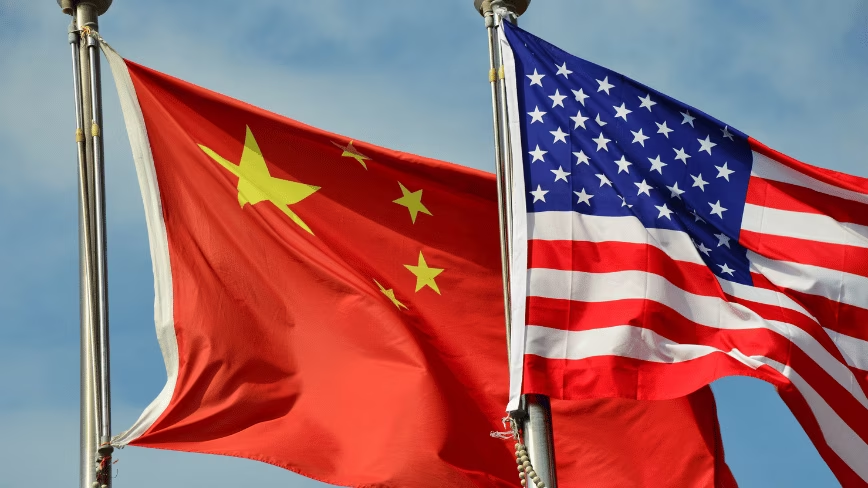
Image: courtesy of Thenextweb
China's Windows 10 Purge: Beijing Accelerates Its Drive for Digital Independence
China’s Ministry of State Security has ordered some state-linked entities to uninstall a customized version of Microsoft’s Windows 10, accelerating a previously planned retirement. The directive, reportedly driven by unspecified data security concerns, marks a significant step in Beijing's broader campaign to reduce its reliance on foreign technology. Microsoft maintains it is unaware of any security incidents affecting the product, which continues to receive regular updates. This move has spurred a rally in Chinese software stocks, while Windows maintains its market dominance in the country's consumer sector.
Outlook
Background
The recent order from China’s Ministry of State Security to remove a custom-built version of Microsoft’s Windows 10 from state-linked entities is not an isolated event, nor is it a sudden shift. It is the latest, and perhaps most assertive, move in a long-standing strategic objective by Beijing: achieving technological self-sufficiency and digital sovereignty.
The specific target here is the "Windows 10 China Government Edition," a version developed by Microsoft in collaboration with China's state-owned China Electronics Technology Group Corporation (CETC) to meet specific security and manageability requirements for government use. This collaboration began in 2017, a direct response to China’s earlier ban on Windows 8 for government computers, also citing security concerns. The idea behind this bespoke operating system was to create a version of Windows that Beijing could trust, offering enhanced transparency and control over data and updates compared to standard consumer or enterprise versions.
However, the current directive, issued on August 18, 2026, suggests that even this tailored approach is no longer sufficient. The stated reason for the accelerated removal is "data security concerns," though no specific vulnerabilities have been detailed by Chinese authorities. Microsoft, for its part, has publicly stated that it is unaware of any security incidents impacting the product and confirms that the government edition continues to receive standard security updates.
This discrepancy points to a larger, policy-driven imperative rather than a reactive technical fix. The Chinese government’s ambition to be "secure and controllable" (安全可控) in its technology stack is a cornerstone of its national strategy. This encompasses everything from semiconductors and networking equipment to operating systems and application software. The goal is multi-faceted: to eliminate potential backdoors, reduce reliance on foreign supply chains vulnerable to geopolitical pressures, and bolster indigenous technological capabilities. This move also aligns with broader global trends of digital nationalism, where nations seek greater control over their digital infrastructure and data.
For China, this is particularly acute given its ongoing technological competition with the United States. The acceleration of this policy, even for a product specifically designed for Chinese government use, indicates a heightened sense of urgency and a tightening of the screws on foreign tech vendors within critical state sectors. It suggests that the definition of 'control' from Beijing's perspective has evolved, moving beyond mere customization to a demand for full indigenous ownership and development.
See also
Precedents
China's drive to replace foreign technology with domestic alternatives is deeply rooted in its economic and national security policies, stretching back decades. The current push for "secure and controllable" technology echoes earlier campaigns, albeit with greater intensity and strategic focus, particularly since the mid-2010s.
One prominent historical precedent is the evolution of China's internet infrastructure. In the early days of the internet, China heavily relied on foreign hardware and software, particularly from the U.S. and Europe. However, over the past two decades, it has systematically built out its own internet giants (Baidu, Alibaba, Tencent) and hardware providers (Huawei, ZTE), creating a largely self-contained digital ecosystem. This process involved significant state investment, protectionist policies, and, at times, direct mandates to favor domestic champions, effectively walling off much of the internet within its borders.
Another parallel can be drawn from the banking sector. In the early 2000s, foreign software dominated core banking systems. Over time, Chinese banks were encouraged, and later mandated, to transition to domestic software solutions, reducing their reliance on foreign vendors like IBM and Oracle. This was a long, arduous process, involving substantial capital allocation and execution risk, but ultimately successful in establishing a robust domestic financial technology infrastructure.
The current situation with operating systems is a continuation of this pattern. Concerns about the security of foreign software in critical government systems date back to at least 2014, when China banned Windows 8 from government procurement lists. This led to the aforementioned collaboration with Microsoft to create the customized Windows 10 Government Edition in 2017. This initial move represented a compromise, where China sought to leverage foreign expertise while gaining greater oversight. However, even this bespoke solution, designed to address some of Beijing's concerns about data control and transparency, now appears to be insufficient.
This suggests an evolving threshold for what constitutes "secure and controllable," moving from a desire for transparency and customization to an insistence on fully indigenous control. The broader context also includes the "Made in China 2025" industrial plan, introduced in 2015, which explicitly aimed to boost domestic content in critical sectors, including information technology. While the plan has been de-emphasized in public rhetoric due to international backlash, its underlying objectives remain a core part of China's long-term economic strategy. The recent actions against Windows 10 are a practical manifestation of these goals, demonstrating a willingness to impose hard deadlines and operational shifts to achieve strategic independence. The consistent pattern shows that when China identifies a sector as strategically important for national security or economic leverage, it will systematically work to reduce foreign influence, often starting with government and state-linked entities before potentially expanding to broader sectors. This historical trajectory indicates that the current move is not an anomaly, but a predictable escalation in a long-term strategic agenda.
This accelerated directive to remove Windows 10 from state agencies extends far beyond a simple software upgrade; it represents a deepening fracture in the global technology order. For Microsoft, it means the erosion of its presence in a crucial, high-security segment of the world's second-largest economy, despite years of effort to tailor its offerings to Chinese demands. The "Government Edition" was a strategic compromise, an attempt by Microsoft to retain market access by accommodating Beijing's sovereignty demands. Its rejection now signals that such compromises may no longer be enough.
The move has profound implications for other foreign technology companies operating in China. If a customized, vetted version of Windows can be deemed a security risk, then virtually any foreign software or hardware component in critical infrastructure could face similar scrutiny and eventual replacement. This creates significant uncertainty for companies like Intel, Qualcomm, Oracle, and others who rely on the Chinese market for a substantial portion of their revenue. It suggests a future where foreign tech may be increasingly confined to the consumer market, or entirely excluded from sensitive government and state-linked sectors, particularly those with national security implications.
For China, this is a clear declaration of intent: digital independence is paramount. It signals a willingness to accept potential short-term operational hurdles for long-term strategic gains. The rally in Chinese software stocks following the announcement underscores investor confidence in domestic alternatives and the government's commitment to fostering a homegrown tech ecosystem. This policy will likely accelerate the development and adoption of Chinese operating systems, cloud services, and enterprise software. While these domestic alternatives may initially lack the maturity and breadth of their Western counterparts, government mandates and preferential treatment will provide a powerful impetus for their growth and refinement.
What comes next is a likely acceleration of what analysts have termed 'tech decoupling'. This shift could eventually lead to a bifurcated global tech landscape, where different nations operate on distinct, nationalized digital stacks, complicating international data flows, interoperability, and global supply chains. The real stakes are not just about market share for a single product, but about the fundamental architecture of the global digital economy and who controls its foundational layers. It forces a reckoning for multinational corporations on how to navigate a world where geopolitical considerations increasingly dictate technological choices and market access.
Scenarios
AnalysisThe removal of Windows 10 from Chinese state agencies opens several distinct paths for both China's domestic tech sector and foreign technology companies, each with its own set of challenges and opportunities.
1. Accelerated Domestic OS Adoption and Refinement: China's domestic operating system developers, such as those behind KylinOS or UOS (Unity Operating System), will see a significant boost. The government mandate provides a guaranteed market and the necessary incentive for further investment and development. While these operating systems have historically struggled with application compatibility and user experience compared to Windows, the sheer scale of government procurement will force rapid iteration and improvement. This could eventually lead to more stable, feature-rich domestic alternatives that could, in the long term, compete in the broader consumer and enterprise markets within China. This outcome would solidify China's digital sovereignty within its state apparatus, but the journey will be long and complex, requiring substantial resources and overcoming technical bottlenecks.
2. Increased Pressure on Other Foreign Tech Vendors: The precedent set by Windows 10 could extend to other foreign software and hardware providers deemed critical for national security. Companies like Intel (processors), Oracle (databases), Cisco (networking equipment), and even foreign cloud service providers could face similar directives to either localize their offerings to an unprecedented degree or be phased out entirely from state-linked entities. This could force foreign companies to make difficult choices between full compliance with China's sovereignty demands or withdrawing from sensitive sectors of the Chinese market, leading to a more fragmented global tech industry. The market incentives for foreign firms to remain in China are immense, but regulatory mechanics and policy fragmentation will create significant execution risk.
3. Challenges in Implementation and Potential Operational Bottlenecks: The transition away from Windows 10, even a customized version, will not be without its difficulties. State agencies have built their workflows, applications, and employee training around the Windows ecosystem for years. Migrating to new, less mature domestic operating systems could lead to compatibility issues with existing legacy software, require extensive retraining of personnel, and potentially cause temporary disruptions in government operations. Procurement bottlenecks for new hardware, labor constraints for training, and the sheer scale of the rollout could create operational messiness. These institutional limitations might slow down the pace of adoption in some areas or necessitate a hybrid approach where certain specialized functions still rely on foreign software for a transitional period, at least until domestic alternatives achieve parity.
4. A Two-Tiered Tech Market in China: It is possible that China will solidify a two-tiered technology market. The state, military, and critical infrastructure sectors would operate almost exclusively on domestic technology, driven by national security and digital sovereignty concerns. Meanwhile, the broader consumer and non-critical enterprise markets might continue to utilize a mix of foreign and domestic technology, where convenience, cost, and global interoperability remain primary drivers. This would allow foreign companies to retain a presence in China's vast consumer market, albeit with reduced influence in strategic areas, creating a complex operating environment for multinational tech firms. This scenario reflects a pragmatic approach to digital sovereignty, balancing national security with economic realities and consumer behavior.
Timeline
Frequently Asked Questions
Discussion
Be the first to share your thoughts.