
As the electric vehicle market continues its complex evolution, the recent acceleration in Chevrolet Silverado EV sales sets a new tone for GM's electric strategy. We can expect General Motors to double down on production at Factory Zero, potentially increasing the availability of both retail and commercial variants of the Silverado EV. Competitors like Ford and Tesla will be closely watching these trends, which may influence their own pricing, feature sets, and marketing efforts in the fiercely contested electric pickup segment. Further investment in charging infrastructure partnerships and consumer education campaigns from GM could also follow, aiming to sustain this newfound momentum and address lingering market concerns.
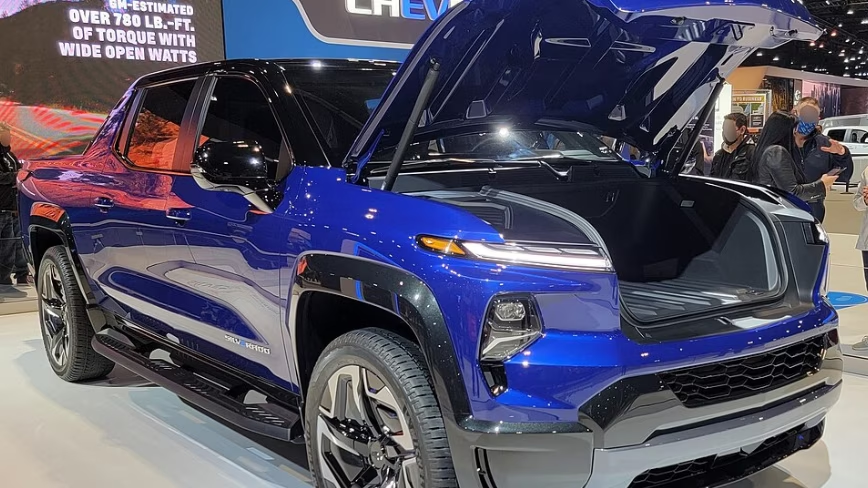
Image: courtesy of Thenextweb
Chevy Silverado EV Sales Surge: What Changed for GM's Flagship Electric Truck?
The Chevrolet Silverado EV, initially hailed for its impressive specifications like a 400-mile range and robust towing capacity, faced an uphill battle with early sales. Despite being positioned as a leading electric pickup, it moved slowly out of showrooms, creating a paradox for General Motors. However, recent data indicates a significant turnaround, with sales nearly doubling in a recent quarter, propelling GM to second place in the electric pickup segment, behind Ford but ahead of Tesla. This unexpected surge suggests a deeper shift in consumer perception, market availability, or GM's strategic execution, challenging the initial narrative that the 'perfect American EV' wasn't finding buyers.
Outlook
Background
The Chevrolet Silverado EV arrived with considerable fanfare, positioned as a direct challenger in the burgeoning, yet challenging, electric pickup truck market. From a technical standpoint, the truck boasted specifications that placed it at the top of its class. CONFIRMED: It offers a range exceeding 400 miles, with the 2026 model reportedly achieving a record 493 miles. CONFIRMED: Its capability includes a maximum tow rating of 12,500 pounds and an 1,800-pound payload capacity, closely matching its gasoline-powered counterpart. CONFIRMED: The Silverado EV is built on GM's Ultium platform alongside the GMC Hummer EV at the company's dedicated Factory Zero facility, a significant investment in electric vehicle production. The truck also features a versatile 'midgate' design, allowing for extended cargo bed length, a feature previously seen in the Chevrolet Avalanche.
However, despite these impressive credentials, initial market reception was muted. CONFIRMED: GM sold approximately 14,000 Silverado EVs in the U.S. and Canada in 2025, a figure dwarfed by the traditional Silverado's sales, which can exceed that volume tenfold in a single quarter. This led to a perception that despite its technical merits, the Silverado EV was struggling to find its footing with consumers. Critics, while acknowledging its range and capability, INFERRED: suggested the premium price point might deter most buyers. The truck's design, INFERRED: with its resemblance to the older Chevrolet Avalanche, also drew mixed reactions, potentially contributing to slower uptake.
Yet, the narrative has recently shifted. CONFIRMED: In a recent quarter, General Motors delivered 7,314 electric pickups, combining sales of the Silverado EV and the GMC Sierra EV. This represents a near doubling of sales for the Silverado EV specifically and secured GM a 28% cumulative segment share, placing it second in the electric pickup category, ahead of Tesla's Cybertruck but still behind Ford's F-150 Lightning. This surge happened even as the broader electric pickup market showed signs of slowing, making the Silverado EV's performance particularly noteworthy.
See also
Precedents
The automotive industry has a long history of new vehicle segments facing initial market skepticism or slow adoption, especially when they represent a significant technological shift. Early hybrid vehicles, for instance, took years to move from niche appeal to mainstream acceptance, requiring extensive consumer education and infrastructure development. Electric vehicles, more broadly, have followed a similar trajectory, with early models struggling with range anxiety and charging limitations before gradually gaining traction.
Pickup trucks, in particular, represent a segment with deep-seated brand loyalty and specific functional expectations. Traditional truck buyers often prioritize proven reliability, towing capability, and a robust dealer service network. The transition to electric powertrains introduces new variables, such as charging times, battery degradation concerns, and the perceived complexity of new technology.
Historically, when a new model or technology underperforms initially, automakers often respond with strategic adjustments. These can include price revisions, increased marketing efforts, targeted fleet sales to build volume and demonstrate capability, or improvements to charging support. The initial rollout of the Ford F-150 Lightning, for example, saw strong early demand driven by brand familiarity and fleet orders, but it has also faced its own production and pricing challenges. Tesla's Cybertruck, despite its unconventional design and significant pre-orders, has had a protracted journey to volume production, leaving a gap for other players.
INFERRED: The Silverado EV's initial slow sales followed this pattern of a promising technology needing time to mature in the market. Its recent sales acceleration suggests that either market conditions have ripened, GM's production has effectively scaled, or a combination of strategic adjustments and growing consumer familiarity with EV trucks is starting to pay dividends. This mirrors how many innovative but initially disruptive products eventually find their market, often after overcoming early hurdles related to cost, perception, and availability.
The sudden acceleration in Chevrolet Silverado EV sales carries significant implications, not just for General Motors but for the entire electric vehicle market and the future of the American pickup truck. For GM, this turnaround offers a critical validation of its multi-billion-dollar investment in the Ultium battery platform and its broader electrification strategy. If the Silverado EV can sustain this momentum, it solidifies GM's position as a serious contender in the electric truck space, a segment crucial to its overall profitability and market relevance.
Beyond GM, this development helps clarify the competitive landscape. The electric pickup market has been closely watched, with Ford's F-150 Lightning, Tesla's Cybertruck, and Rivian's R1T vying for dominance. The Silverado EV's rise to second place, surpassing Tesla in recent sales, indicates that traditional automakers can successfully leverage their established brand loyalty and dealer networks to compete effectively against newer EV-focused entrants. This could pressure competitors to innovate faster, adjust pricing, or enhance their own offerings to maintain market share.
For consumers, a strong performing Silverado EV means more robust choices in the electric truck segment. As more capable and competitively priced options become available, it lowers the barrier for traditional truck owners to consider an electric alternative, potentially accelerating the overall transition away from internal combustion engines. This, in turn, could drive further investment in charging infrastructure and more advanced battery technology, creating a positive feedback loop for the entire EV ecosystem. It also shows that even a technically excellent product might need time and strategic adjustments to connect with its target audience.
Scenarios
AnalysisThe recent surge in Chevrolet Silverado EV sales could lead to several distinct outcomes for General Motors and the broader electric vehicle industry.
Outcome 1: Sustained Market Leadership and Expanded Production.
If the Silverado EV continues its upward sales trajectory, INFERRED: GM will likely prioritize increasing production at Factory Zero to meet demand. This would solidify its position as a dominant player in the electric pickup segment, potentially challenging Ford for the top spot. SPECULATIVE: GM might introduce more trim levels or specialized variants, such as a more affordable entry-level model or a higher-performance off-road version, to capture a wider range of buyers. This sustained success could also lead to further investment in GM's Ultium battery technology, potentially lowering costs and improving performance across its entire EV lineup. The company could also leverage this success to expand its charging network partnerships or offer more aggressive charging incentives to Silverado EV owners.
Outcome 2: Intensified Competition and Price Wars.
The Silverado EV's growing market share will almost certainly intensify competition with Ford, Tesla, and Rivian. INFERRED: Ford, currently leading the segment, will be pressured to defend its position, potentially through new F-150 Lightning features, price adjustments, or increased marketing. SPECULATIVE: Tesla, now trailing GM in this specific segment, may accelerate Cybertruck production or introduce new capabilities to regain ground. This heightened competition could lead to price adjustments across the board as manufacturers vie for market share, benefiting consumers with more affordable options. It could also spur a 'features race,' with companies adding more advanced technology, longer ranges, or faster charging capabilities to differentiate their trucks. However, a price war could also squeeze profit margins for all manufacturers, making the path to EV profitability more challenging.
Outcome 3: Shifting Focus to Commercial Fleets.
While some Silverado EV models target retail buyers, GM has also emphasized its Work Truck (WT) variants for commercial use. INFERRED: The recent sales increase could be significantly driven by large fleet orders, which often come with slower initial ramp-ups but then generate substantial, steady demand. SPECULATIVE: If this is the case, GM might increasingly tailor its production and marketing efforts toward commercial clients, focusing on total cost of ownership, durability, and integration with fleet management systems. This could lead to a stable, profitable niche for the Silverado EV, even if retail sales growth moderates. However, a heavy reliance on fleet sales might mean less focus on high-margin retail innovations, potentially ceding some of the 'premium' electric truck market to competitors focused on individual buyers.
Timeline
2022-01-05
Chevrolet Silverado EV Unveiled
General Motors officially introduced the Chevrolet Silverado EV at CES, showcasing its Ultium platform, 400-mile range, and innovative features like the midgate. Initial production was slated for early 2023.
2023-04-03
Silverado EV Production Begins at Factory Zero
Production of the Chevrolet Silverado EV began at GM's Factory Zero assembly plant, alongside the GMC Hummer EV. Initial units were primarily for fleet customers, with retail models to follow.
2025-12-31
Initial Sales Figures for 2025 Reported
GM sold approximately 14,000 Silverado EVs across the U.S. and Canada in 2025, leading to industry observations about slower-than-expected uptake despite the truck's capabilities.
2026-07-03
Recent Sales Surge Reported
Reports indicate GM delivered 7,314 electric pickups (Silverado EV and Sierra EV combined) in a recent quarter, nearly doubling Silverado EV sales and securing 28% market share, placing GM second in the segment.
Frequently Asked Questions
The Chevrolet Silverado EV boasts a range of over 400 miles on a single charge. The 2026 model, in particular, has been cited for setting an EV range record at 493 miles.
Discussion
Be the first to share your thoughts.