
The quiet policy change by OpenAI suggests a proactive, albeit unannounced, effort to mitigate its legal exposure amidst ongoing copyright disputes. We can expect this strategy to continue, possibly leading to further refinements in how its large language models (LLMs) interact with copyrighted material. This move could also prompt other major AI developers to review and adjust their own content generation policies, aiming to avoid similar legal challenges. For users, the immediate impact is a reduced capability for style mimicry, pushing them towards more generic or theme-based prompts. Over time, this could foster a new creative dynamic, where AI assists in content generation but avoids direct stylistic appropriation, or it could spur demand for AI models that operate under different legal frameworks or with explicit licensing agreements.
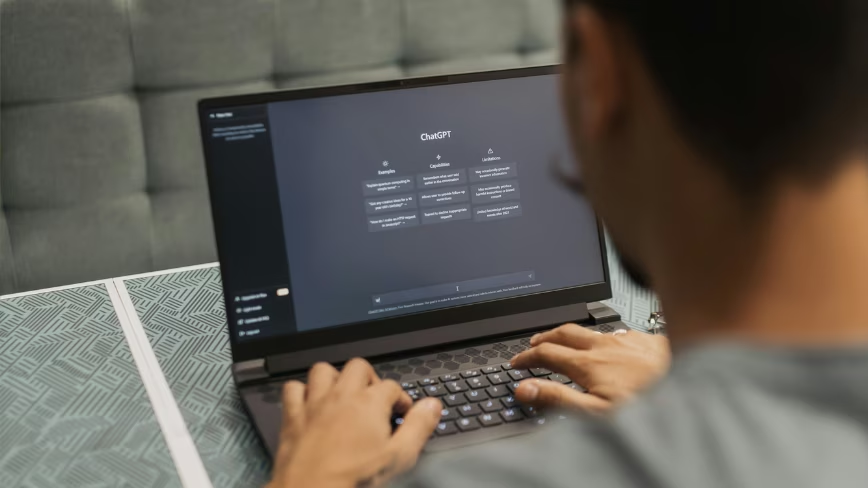
Image: courtesy of Thenextweb
OpenAI's Quiet Copyright Retreat: What ChatGPT's Refusal to Imitate Authors Means for AI and Content Creation
ChatGPT, OpenAI's flagship AI chatbot, has recently updated its policies to decline requests to imitate the writing styles of specific authors, both living and deceased. This shift, which OpenAI has not publicly announced, is a direct response to a growing number of copyright lawsuits filed by authors against the company. Users attempting to prompt the AI for content in the style of figures like Stephen King or Agatha Christie now receive refusals, with the chatbot citing intellectual property concerns. While ChatGPT can still generate content based on genre themes or stylistic hallmarks, the direct mimicry of authorial voice is now off-limits, creating significant implications for developers, creators, and the evolving legal landscape of generative AI.
Outlook
Background
The decision by OpenAI to block ChatGPT from imitating specific authors' styles comes as the company faces a wave of high-profile lawsuits from writers and artists. These legal challenges, which gained momentum in the period leading up to mid-2026, allege that AI models were trained on copyrighted material without permission or compensation, and that their output constitutes copyright infringement. Authors like Sarah Silverman, Mona Awad, Paul Tremblay, and others have initiated legal action, claiming that their works were used to train AI models, enabling these systems to generate content that infringes on their intellectual property. The core of these lawsuits centers on whether the act of training an AI on copyrighted data, and the subsequent generation of content that mirrors an author's distinct style, constitutes a 'fair use' of the material or a violation of copyright. OpenAI's unannounced policy change, confirmed by multiple independent tests on July 28, 2026, appears to be a defensive measure, an attempt to pre-empt further legal battles and reduce the scope of potential damages or injunctive relief. The chatbot itself now directly references copyright protection when declining style imitation requests, indicating an internal policy directive has been implemented.
Precedents
The tension between technological advancement and intellectual property rights is not new. Historically, every major shift in media or content creation has brought with it new debates over copyright and fair use. The advent of photocopiers sparked debates over reproduction rights, VCRs led to landmark cases concerning home recording, and the internet ushered in two decades of legal battles over digital distribution and peer-to-peer sharing. In each instance, new technologies challenged existing legal frameworks, forcing courts, legislatures, and companies to adapt. The music industry's struggle with digital sampling and file-sharing serves as a particularly relevant precedent. Initially, artists and record labels fiercely resisted sampling, leading to numerous lawsuits. Over time, a system of licensing and clear guidelines emerged, allowing for creative use while ensuring compensation. Similarly, the early days of search engines faced copyright claims over indexing and displaying snippets of content, eventually settling into accepted practices based on 'transformative use' and implied licenses. The current situation with generative AI and authorial style imitation follows this pattern closely, suggesting that an eventual legal and commercial framework will emerge, likely involving new forms of licensing or a clearer definition of AI's 'fair use' boundaries.
This seemingly minor adjustment in ChatGPT's functionality carries significant weight for several reasons. For authors and creators, it signals a potential, albeit slow, victory in their fight for intellectual property rights in the age of AI. It suggests that the legal pressure they are exerting is having a tangible effect on how AI models are designed and deployed. For OpenAI and other AI developers, it highlights the immense execution risk associated with operating in a legally ambiguous space. The ability of AI to mimic human creativity was a core selling point, and restricting this capability, even partially, could impact user perception and the utility of their platforms. Furthermore, this move sets a precedent for how AI companies might self-regulate or be regulated in the future. It could lead to a bifurcation of AI models: those that rigorously avoid copyrighted styles and those that seek to license content explicitly. The broader implication is a reshaping of the creative economy, where the lines between AI-generated content and human authorship become clearer, and the economic value of distinct creative styles is either protected or redefined.
Scenarios
AnalysisOne immediate outcome is that authors and creative rights organizations will likely view this as validation of their legal efforts, potentially encouraging more lawsuits or stronger demands for compensation and attribution. The ongoing litigation against OpenAI and other AI companies could intensify, with this policy change being cited as evidence of the companies' recognition of copyright issues.
Another outcome is that developers building applications on top of OpenAI's models will need to adjust their strategies. If their products relied on the ability to generate content in specific authorial styles, they will now face functional limitations, potentially requiring them to pivot their offerings or explore alternative AI models that may have different capabilities or legal postures. This could fragment the AI ecosystem, with different models specializing in different types of content generation based on their adherence to intellectual property guidelines.
It is also plausible that OpenAI, or other AI firms, may eventually seek to establish formal licensing agreements with authors and publishers. This would create a new revenue stream for creators and a legally clearer path for AI models to incorporate stylistic elements, potentially leading to a more structured marketplace for 'AI-trainable' content. However, such a system would be complex to implement, requiring industry-wide consensus on compensation models and usage terms.
Timeline
Frequently Asked Questions
Discussion
Be the first to share your thoughts.