
This article explores the practical implications of BMW's energy-positive Deep Orange 17 prototype. It moves beyond the simple fact that the vehicle works, examining what this concept means for the future of electric vehicles, the persistent challenges of integrating solar power into automotive design, and how major automakers like BMW are using such projects to inform their long-term sustainability and energy strategies. We will look at the real-world hurdles that stand between a successful research prototype and a mass-market product, as well as the potential shifts in consumer behavior this technology could enable.
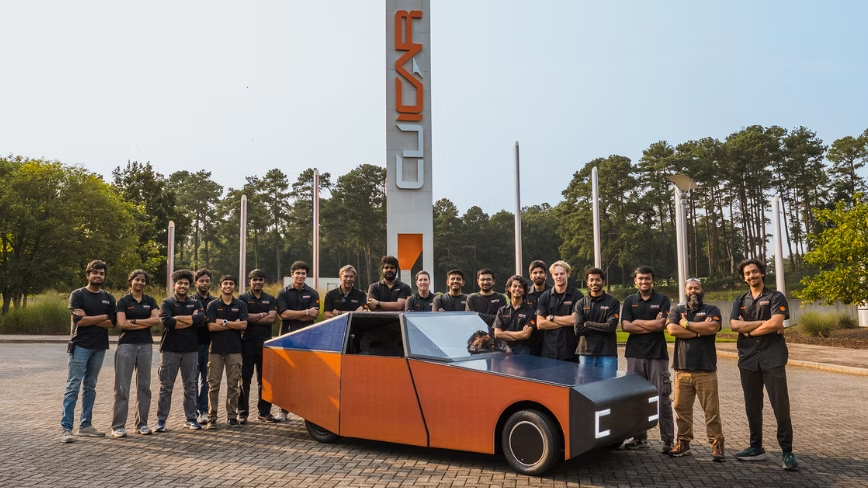
Image: courtesy of Thenextweb
BMW's Energy-Positive Solar EV Prototype Hints at a Future Beyond the Charging Station
BMW challenged graduate students at Clemson University to design an electric vehicle that could generate more energy than it consumed during a typical urban commute. The result, Deep Orange 17, is a lightweight prototype covered in 1,700 solar cells, capable of producing 31 miles of range daily—significantly more than the 12 miles needed for its modeled commute. While not intended for production, the project, completed in 2026, pushes the boundaries of vehicle-integrated solar technology and is set to debut at CES 2027.
Outlook
Background
Automakers and energy researchers have long pursued the vision of a truly self-sufficient vehicle, one that could recharge itself without relying solely on the grid. This aspiration recently took a significant step forward when BMW issued a direct challenge to the graduate students of Clemson University's Deep Orange program. The goal was ambitious: create an electric vehicle that generates more energy than it consumes in a day of typical urban driving.
Two years after the challenge was issued in Fall 2024, the students delivered Deep Orange 17, a vehicle that fundamentally redefines the concept of range in electric mobility. This prototype, a mere 1,212 pounds, integrates more than 1,700 photovoltaic cells directly into its exterior surfaces. These cells, developed in collaboration with Germany's Fraunhofer Institute for Solar Energy Systems ISE, are designed to harvest energy continuously, whether the vehicle is parked, in motion, or idling in traffic. Their innovative construction allows them to generate power even when only portions of the panel are exposed to sunlight.
Under modeled conditions, Deep Orange 17 produces an impressive 31 miles of surplus range each day. This figure stands in stark contrast to the estimated 12 miles required for an average urban commute, making the vehicle genuinely 'energy positive' for its intended use case. This surplus energy means the car could effectively extend its range without ever needing to plug into a traditional charging station for daily use, or even feed excess power back into a home or grid system. The project was completed in 2026, and the prototype is slated for a public debut at CES 2027. BMW has made it clear that while this is a groundbreaking proof-of-concept, Deep Orange 17 is not intended for mass production.
Precedents
The idea of integrating solar panels into vehicles is not new, but its practical application has historically faced significant hurdles. Early attempts often involved small, auxiliary solar panels on roofs, primarily designed to power ventilation systems or trickle-charge 12-volt accessory batteries, offering negligible impact on propulsion. Think of the optional solar roof on some Toyota Prius models, which provided minor climate control benefits but no significant range extension.
More recently, a handful of startups have ventured into designing solar-first electric vehicles. Companies like Lightyear and Aptera have developed sleek, aerodynamically optimized cars heavily reliant on integrated solar panels to provide significant daily range. Lightyear's Lightyear 0, for example, claimed to add up to 43 miles of range per day from its solar array, though it came with a hefty price tag and faced production challenges that ultimately led to its insolvency. Aptera, with its distinctive three-wheel design, promises even greater solar contribution and efficiency, but remains in the pre-production phase. These efforts, while innovative, have struggled with the twin challenges of cost-effectiveness and scaling production, often resulting in niche products with limited market reach.
What sets the Deep Orange 17 apart from many of these predecessors is not just its energy-positive claim, but the institutional backing of BMW. While the prototype itself isn't a production vehicle, BMW's direct involvement signals a serious research interest from a major global automaker in pushing the boundaries of vehicle-integrated photovoltaics (VIPV). Previous attempts by larger manufacturers to significantly integrate solar have been cautious, often limited by the desire to maintain traditional vehicle aesthetics, manage costs, and ensure durability. The Deep Orange 17 project suggests a willingness to explore more radical integration, prioritizing energy generation as a core design principle, even if only in a research context. This shift from minor accessory power to a fundamental energy source marks a potential turning point in how manufacturers approach solar integration, moving beyond incremental gains to genuinely transformative concepts.
The Deep Orange 17 project, despite being a prototype, carries significant implications for the future of electric mobility and energy policy. Its core achievement — generating more energy than it consumes for a daily commute — fundamentally reorients the conversation around electric vehicles from 'range anxiety' to 'energy independence.' For a typical driver, the idea of a vehicle that rarely, if ever, needs to be plugged in for routine use would transform the ownership experience, removing a major friction point that still deters some consumers from adopting EVs.
For BMW, and the broader automotive industry, the project serves as a high-profile proof-of-concept for vehicle-integrated photovoltaics (VIPV). It demonstrates that with sufficient innovation in cell design, integration techniques, and lightweight materials, solar can move beyond a supplementary power source to a primary one. This research could directly inform the development of future BMW models, leading to more efficient, though perhaps not fully energy-positive, solar integration across its EV lineup. Even adding a few miles of 'free' range daily could significantly reduce reliance on public charging infrastructure and lower charging costs for owners.
Beyond individual vehicle performance, an energy-positive car hints at a future where vehicles could contribute to, rather than just consume from, the electrical grid. Imagine millions of cars parked during the day, quietly generating power and potentially feeding it back into homes or the grid through vehicle-to-grid (V2G) systems. This could help stabilize grids, reduce peak demand, and accelerate the transition to renewable energy sources, especially as urban populations grow and energy demands intensify. The focus on harvesting energy while parked is particularly important, as most cars spend the vast majority of their time stationary, turning what was once dead time into productive energy generation.
The Deep Orange 17 also highlights the critical role of academic partnerships in pushing technological frontiers. By outsourcing such an ambitious, blue-sky challenge to a university program like Clemson's Deep Orange, BMW gains access to fresh perspectives and unconstrained design thinking, often circumventing the more conservative, production-focused constraints of internal R&D departments. This collaborative model could become increasingly vital for automakers looking to accelerate innovation in a rapidly evolving industry.
Scenarios
AnalysisThe success of the Deep Orange 17 prototype, while not signaling an immediate product launch, sets the stage for several significant developments within the automotive and energy sectors.
One likely outcome is the accelerated integration of advanced VIPV technology into mainstream electric vehicles, even if not to the 'energy-positive' extreme. The research from the Deep Orange project provides invaluable data on cell efficiency, durability, and practical integration challenges. This suggests that future BMW EVs, and potentially those from other manufacturers, could feature more extensive and efficient solar arrays designed to significantly extend range or power auxiliary systems. These might not make a car fully energy-positive for all uses, but they could add a meaningful 10-20 miles of daily range, reducing the frequency of charging and enhancing convenience for drivers. BMW's investment in this research indicates a strategic interest in leveraging such innovations, even if implementation is gradual and modular.
A second potential outcome is the emergence of highly specialized, lightweight energy-positive vehicles for specific urban or regional use cases. While Deep Orange 17 itself is not for production, its design principles could inspire a new class of ultra-efficient, perhaps smaller or two-seater, urban mobility solutions. These vehicles could cater to commuters with predictable, shorter routes, offering near-total energy independence and minimal environmental footprint. This could create a niche market for truly self-sufficient personal transport, distinct from the broader EV market dominated by larger family vehicles and SUVs.
A third, more speculative outcome involves broader industry adoption and the redefinition of vehicle energy management. The public debut of Deep Orange 17 at CES 2027 could spur other major automakers to intensify their own VIPV research and development. This competition could lead to rapid advancements in solar cell technology, materials science, and battery management systems. Over the longer term, this might result in a future where solar panels are a standard, expected feature on most EVs, contributing meaningfully to their energy budget and potentially enabling widespread vehicle-to-grid (V2G) capabilities, allowing cars to act as mobile energy storage units and even power homes during outages.
Finally, the project could influence future regulatory frameworks and infrastructure planning. As the technical feasibility of energy-positive vehicles becomes clearer, policymakers may begin to consider incentives for their development and adoption, or even integrate their potential into urban planning for charging infrastructure. This could shift thinking from merely providing charging points to fostering a more distributed, self-sustaining energy ecosystem, with vehicles playing an active role.
Timeline
2024-09-01
BMW Issues Challenge to Clemson
BMW challenges graduate students in Clemson University's Deep Orange program to design an electric vehicle that generates more energy than it consumes during a typical urban commute.
2026-08-07
Deep Orange 17 Project Completed and Announced
The Deep Orange 17 prototype, also referred to as Luminetta, is completed by Clemson students. News breaks on this date about the vehicle's successful demonstration of being 'energy positive' for an average 12-mile commute, generating 31 miles of range daily from 1,700 integrated solar cells.
2027-01-05
Prototype Debuts at CES 2027
The Deep Orange 17 prototype is scheduled to make its public debut at the Consumer Electronics Show (CES) in Las Vegas, offering a wider audience a first look at BMW's vision for an energy-positive EV concept.
Frequently Asked Questions
Deep Orange 17 is a prototype electric vehicle designed and built by graduate students at Clemson University's Deep Orange automotive engineering program, in response to a challenge from BMW. It is also sometimes referred to as Luminetta. The vehicle is notable for being 'energy positive,' meaning it generates more energy from its integrated solar panels than it consumes for a typical daily commute.
Discussion
Be the first to share your thoughts.