
Expect continued scrutiny of the Brain Research Rehabilitation Institute's operational model as it seeks to develop and commercialize treatments for brain injury and stroke. The success or failure of its initial for-profit spin-outs will offer crucial early data points on the viability of Ackman's hybrid approach. If successful, this model could attract more philanthropic capital towards similar 'venture philanthropy' structures, potentially influencing how future medical research and other social impact initiatives are funded. Conversely, significant challenges in commercialization or perceived conflicts of interest could temper enthusiasm for widespread adoption.
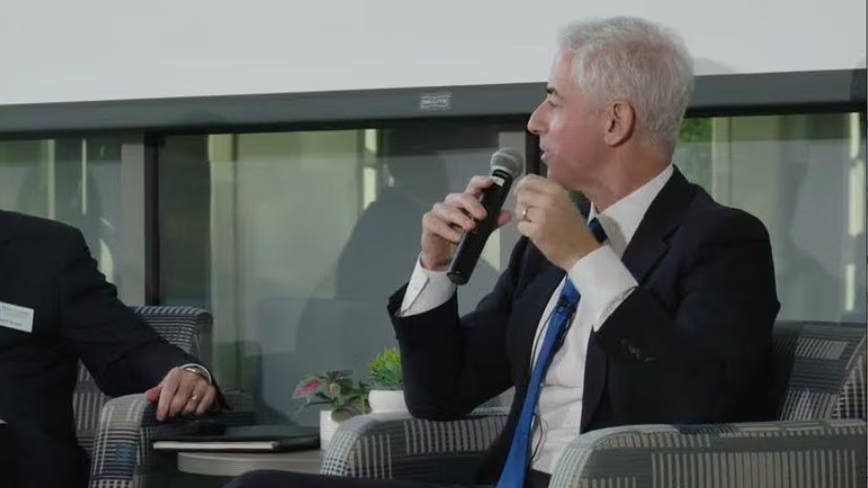
Image: courtesy of Thenextweb
Bill Ackman's Hybrid Philanthropy: What Blending For-Profit Incentives with Non-Profit Capital Means for Research
Billionaire investor Bill Ackman has publicly aligned himself with Jeff Bezos's view that building successful, for-profit ventures can create more significant social impact than traditional charitable giving. Ackman is putting this philosophy into practice with his new Brain Research Rehabilitation Institute, which blends non-profit capital with a structure designed to spin out for-profit companies. This approach challenges conventional philanthropic models by seeking to leverage market incentives to address complex societal problems, particularly in medical research, by focusing on areas where traditional capital markets fall short.
Outlook
Background
The traditional divide between philanthropy and enterprise has long been a subject of debate. Charitable giving, often in the form of grants to non-profits, aims to address societal needs without direct financial return. For-profit companies, by contrast, focus on innovation and efficiency driven by market demand and the pursuit of profit. Bill Ackman, the founder of Pershing Square, has now explicitly positioned himself alongside Amazon founder Jeff Bezos in advocating for the latter approach as a more potent force for societal improvement. Bezos has often stated that his companies, like Amazon and Blue Origin, create more value for the world through job creation, innovation, and economic activity than his direct charitable donations. Ackman's agreement with this philosophy, however, comes with a distinct operational twist: he is not abandoning philanthropy entirely but attempting to redesign it. His new venture, the Brain Research Rehabilitation Institute, is a hybrid entity. It receives initial non-profit capital, but its core mission involves fostering the creation of for-profit companies. These spin-outs are intended to develop tangible solutions—such as medical devices, new molecules, and treatments—specifically for patients suffering from brain injuries and strokes. A critical aspect of this model is the compensation structure for the institute's staff, which includes equity sharing in these spin-out companies. This mechanism directly links the financial success of the commercial ventures to the personal incentives of the researchers and developers, mirroring the performance-based compensation structures common in private equity firms like Pershing Square. Ackman has stated that his goal, informed by two decades of philanthropic experience, is to identify and address 'gaps in the capital markets' where traditional investment might be hesitant due to high risk or long development timelines, but where significant societal needs exist.
Precedents
The concept of blending philanthropic goals with market-driven mechanisms is not entirely new, but Ackman's specific model represents a more explicit integration. Historically, venture philanthropy emerged in the late 20th century, seeking to apply venture capital principles—like active engagement, long-term funding, and capacity building—to non-profit organizations. This often involved providing more than just financial grants, extending to strategic advice and operational support.
Similarly, impact investing, which gained traction in the early 2000s, focuses on investments made with the intention to generate positive, measurable social and environmental impact alongside a financial return. This includes areas like sustainable agriculture, affordable housing, clean energy, and accessible healthcare.
University technology transfer offices also operate on a related principle, taking publicly funded research and attempting to commercialize it through licensing or spin-out companies. The revenue generated often flows back to the university and researchers, creating an incentive for innovation with real-world applications.
What sets Ackman's Brain Research Rehabilitation Institute apart is its foundational design: it starts with non-profit capital but is inherently structured to create for-profit entities, with staff directly incentivized through equity. This differs from traditional impact funds that invest in existing social enterprises, or university models that often license intellectual property. Ackman's model is more akin to an internal incubator, using charitable funds as initial seed capital for a venture studio that then aims for market-rate returns and social impact simultaneously. This structure aims to overcome the 'valley of death' often faced by early-stage scientific research, where promising discoveries struggle to secure the significant, long-term funding needed to transition from lab to market.
The convergence of Bill Ackman and Jeff Bezos on the idea that commerce can be the most powerful form of philanthropy has significant implications for how societal problems are addressed and funded. For patients suffering from debilitating conditions like brain injury and stroke, Ackman's model offers a potential new pathway for accelerated development of treatments. Traditional pharmaceutical research is often driven by the largest addressable markets, leaving conditions affecting smaller populations or requiring complex, long-term research underfunded. By using philanthropic capital to bridge these 'capital market gaps,' Ackman's institute could unlock innovation in areas that might otherwise be neglected.
For the scientific community, this model presents both opportunities and challenges. On one hand, it could provide a more stable, results-oriented funding stream compared to the often sporadic and competitive grant system. The equity-sharing model could also attract top talent to roles that combine scientific discovery with entrepreneurial drive. On the other hand, it raises questions about academic freedom, the potential for research priorities to be swayed by commercial viability, and the ethics of profiting from medical advancements initially funded by charitable donations.
More broadly, if Ackman's Brain Research Rehabilitation Institute proves successful, it could redefine the role of philanthropy itself. Instead of merely being a dispenser of funds, philanthropy could evolve into a more active, entrepreneurial force that directly participates in market creation and solution delivery. This shift could lead to a more efficient allocation of charitable capital, focusing on sustainable, scalable solutions rather than temporary aid. However, it also demands a higher level of financial and operational sophistication from philanthropic organizations, blurring the lines between charity, investment, and business.
Scenarios
Analysis1. Increased Venture Philanthropy Adoption: If the Brain Research Rehabilitation Institute successfully launches multiple commercially viable for-profit spin-outs that deliver effective treatments, it could serve as a powerful proof of concept. This success might encourage other high-net-worth individuals and foundations to explore similar hybrid models, diverting more philanthropic capital towards 'venture philanthropy' or 'impact investing' approaches that prioritize market-driven solutions for social good. This could lead to a new wave of funding mechanisms for complex scientific and social challenges, particularly in areas like rare diseases or underserved public health needs.
2. Enhanced Commercialization of Medical Research: The institute's model could create a more direct and efficient pipeline for translating basic scientific discoveries into accessible medical products. By embedding market incentives and entrepreneurial structures from the outset, it aims to overcome the historical hurdles of commercialization that often plague academic research. This could result in faster development cycles for devices, therapies, and drugs for brain injury and stroke patients, ultimately improving patient outcomes.
3. Criticism and Ethical Debates: The hybrid model, while potentially efficient, could also draw criticism regarding potential conflicts of interest. The pursuit of profit, even when seeded by philanthropy, might be seen by some as inherently conflicting with the public good, particularly in healthcare where accessibility and affordability are paramount. Debates may arise concerning the pricing of treatments developed through this model and how equity sharing aligns with the ethical principles of non-profit research.
4. Limited Scalability or Operational Challenges: The success of such a model heavily relies on exceptional leadership, a deep understanding of both scientific research and venture capital, and the ability to navigate complex regulatory landscapes. It is possible that while Ackman's specific institute may find success, the model might not be easily replicable by other philanthropic entities lacking similar expertise or risk tolerance. Operational complexities, difficulties in attracting the right talent, or challenges in securing subsequent rounds of funding for spin-outs could limit its widespread adoption.
Timeline
2026-08-07
Ackman Aligns with Bezos on Impact Philosophy
Bill Ackman publicly agrees with Jeff Bezos's stance that building successful companies can create more social impact than traditional philanthropy, signaling a shift in his approach to charitable endeavors.
2026-08-07
Brain Research Institute Model Revealed
Details emerge about Ackman's new Brain Research Rehabilitation Institute, which is structured to use non-profit capital to seed for-profit spin-out companies focused on treatments for brain injury and stroke, with staff receiving equity.
2026-08-09
Ongoing Operational Development
As of this date, the Brain Research Rehabilitation Institute is in its early operational phases, working to establish its research programs and identify potential spin-out ventures. Its long-term success will depend on its ability to develop and commercialize viable medical solutions.
Frequently Asked Questions
It's a new venture founded by Bill Ackman that combines non-profit funding with a for-profit business model. It aims to develop treatments for brain injury and stroke patients by spinning out commercial companies, with staff sharing in the equity of these ventures.
Discussion
Be the first to share your thoughts.