
Over the next several months, the Firebird AI factory in Hrazdan is expected to ramp up its operations, steadily increasing its GPU count towards the stated goal of 70,000 units by 2027. This scale-up will likely drive demand for skilled technical talent within Armenia, potentially accelerating the development of the country's domestic AI and data science sectors. Regionally, the factory's presence could foster new collaborations and attract further tech investment, particularly from countries within the CIS and beyond, as evidenced by the presence of Kazakhstan's deputy prime minister at the opening. However, the factory's reliance on US technology and its strategic location may also draw increased scrutiny from geopolitical rivals, potentially complicating its operational environment and future expansion plans.
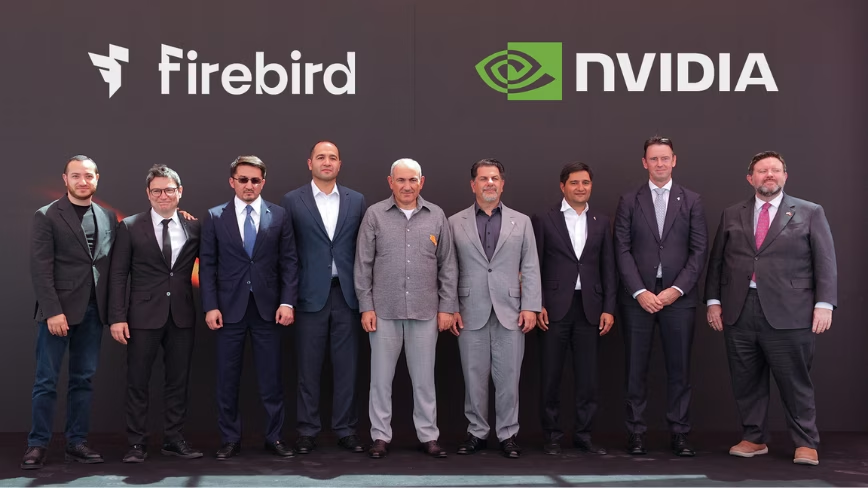
Image: courtesy of Thenextweb
Armenia's New AI Factory: Washington's Strategic Tech Play in a Contested Region
Armenia has officially opened the largest AI factory in the Commonwealth of Independent States (CIS) region, a project led by US-based Firebird and enabled by a specific US export license. This $5 billion initiative, which aims to house 70,000 NVIDIA GPUs by 2027, marks a significant technological and geopolitical development, positioning Armenia as a potential hub for advanced computing while signaling Washington's strategic engagement in the South Caucasus.
Outlook
Background
On August 8, 2026, Armenia officially launched the first phase of what is now the largest artificial intelligence computing factory in the Commonwealth of Independent States (CIS) region, located in Hrazdan. The project is spearheaded by Firebird, a US-based AI cloud infrastructure provider. This initial phase represents an investment of over $500 million, with a total projected investment reaching roughly $5 billion.
The factory's core infrastructure relies on advanced NVIDIA GPUs, with plans to scale its capacity to 70,000 GPUs by 2027. Crucially, this ambitious undertaking was made possible by a specific export license granted by the US government. The presence of Kazakhstan’s deputy prime minister at the factory's inauguration underscores the regional interest in this development.
Armenia, a country situated in the geopolitically sensitive South Caucasus, shares borders with Turkey, Georgia, Azerbaijan, and Iran, placing it at a crossroads of regional and global power dynamics. Its relationship with the US has seen increasing engagement, particularly as Washington seeks to diversify partnerships in regions traditionally influenced by Russia. For Firebird, operating such a large-scale AI infrastructure facility in Armenia allows it to tap into a growing regional market for AI services and potentially access a skilled, cost-effective workforce.
Precedents
The decision by the United States to grant an export license for advanced AI hardware to Armenia, and for a US company like Firebird to establish such a significant facility, aligns with a broader pattern of strategic tech engagement by Washington in regions where geopolitical influence is contested. Historically, the US has used technology transfer and investment as tools to foster economic development and strengthen partnerships with allies, particularly in areas bordering rivals. Examples include initiatives in Eastern Europe and Central Asia, aiming to bolster local economies and create alternatives to reliance on other major powers.
The US government also employs stringent export controls on advanced technologies, especially those with potential dual-use civilian and military applications, to prevent their acquisition by adversarial nations. The granting of a license for 70,000 NVIDIA GPUs, which are critical for high-performance AI computing, signals a deliberate policy choice by Washington to enable this specific venture, bypassing the very controls typically applied to such equipment. This indicates a clear strategic intent to foster a US-aligned technological presence in the region.
For Armenia, attracting foreign direct investment in high-tech sectors has been a long-term economic goal. The country has a strong diaspora and a growing, highly educated tech workforce, often cited as a key asset. Previous attempts to build a robust tech sector have yielded mixed results, but this project, backed by significant US capital and technology, represents a new scale of ambition. The involvement of a US company also mirrors how global tech infrastructure has been built in recent decades, often with core hardware and software originating from American firms, even when deployed internationally.
This new AI factory in Armenia is more than just a large computing facility; it represents a tangible manifestation of a shifting geopolitical and technological strategy. For the United States, granting the export license and supporting Firebird's venture in Armenia signifies a strategic move to deepen its economic and technological ties in the South Caucasus. This could serve to counterbalance the influence of other regional powers and establish a US-aligned tech footprint in a critical corridor. It also demonstrates a willingness to use advanced technology as a tool of foreign policy, carefully selecting partners for high-value investments.
For Armenia, the factory could be transformative. A $5 billion investment is substantial for an economy of its size, potentially creating thousands of high-skilled jobs, stimulating local innovation, and attracting further foreign capital. It positions Armenia as a serious player in the global AI landscape, potentially fostering a brain drain reversal as skilled professionals find advanced opportunities at home. The factory's capacity to host 70,000 GPUs could also make Armenia a regional hub for AI research and development, providing computing power to universities, startups, and enterprises across the CIS and beyond. However, this increased prominence also comes with risks, as Armenia becomes a focal point in the broader technological competition between global powers, potentially exposing it to cyber threats or political pressures from those viewing the project with suspicion.
Scenarios
AnalysisOne possible outcome is that the Firebird AI factory successfully scales its operations, reaching its 70,000 GPU target by 2027. This could firmly establish Armenia as a key regional player in AI infrastructure, drawing in further foreign direct investment and fostering a vibrant domestic tech ecosystem. The availability of such significant computing power might accelerate scientific research and technological innovation across the CIS region, with Armenia serving as a crucial node for data processing and AI model training. This scenario would validate the US strategy of using targeted tech investment to build alliances and project influence, while providing substantial economic uplift for Armenia.
Alternatively, the project could face significant headwinds. Geopolitical tensions in the South Caucasus are persistent, and the factory's explicit US backing might make it a target for various forms of pressure or interference from rival powers. Operational challenges, such as securing a consistent supply chain for future expansions, managing the complex technical infrastructure, or attracting and retaining sufficient high-skilled talent in a competitive global market, could also slow its growth. Should the factory fail to achieve its full potential or become embroiled in regional disputes, it could undermine confidence in Armenia's ability to host large-scale advanced tech projects and lead to a more cautious approach from future investors.
Timeline
Frequently Asked Questions
Discussion
Be the first to share your thoughts.