
The unveiling of AMD's Helios rack and MI455X accelerator signals a renewed and intensified competition in the high-stakes AI hardware sector. We can expect a period of aggressive benchmarking and marketing from both AMD and Nvidia, as each company seeks to prove superior performance and cost-effectiveness for AI workloads. The market will be watching closely how quickly AMD can ramp up production and delivery of these new systems in the second half of 2026. Customer adoption, particularly among the hyperscalers and large AI model developers, will be a critical indicator of AMD's success in chipping away at Nvidia's substantial market share. Furthermore, the emphasis on open interconnects like UALink and Ultra Ethernet suggests a strategic push by AMD to offer alternatives to Nvidia's proprietary NVLink, which could influence future data center infrastructure designs.
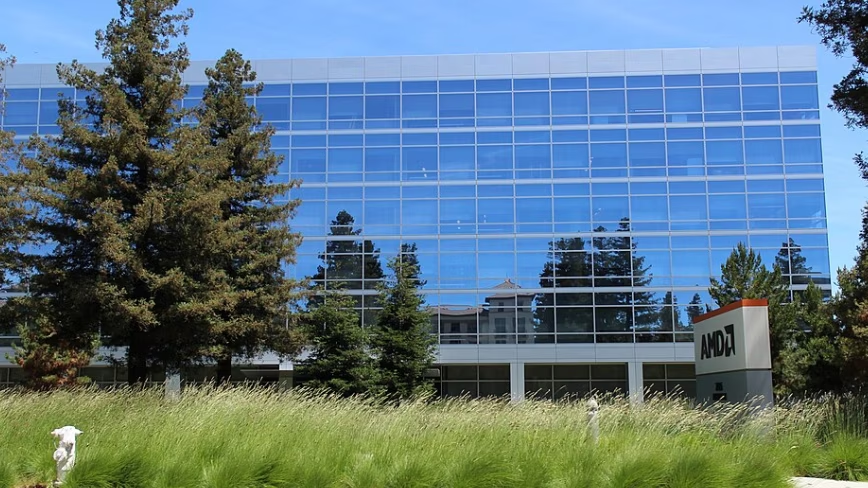
Image: courtesy of Thenextweb
AMD's AI Play: How Helios and MI455X Challenge Nvidia's Rack-Scale Grip
AMD unveiled its new Helios rack-scale system and the MI455X AI accelerator yesterday, July 23, 2026, marking its most direct challenge yet to Nvidia's dominance in the artificial intelligence infrastructure market. The MI455X boasts an impressive 432GB of HBM4 memory, a significant increase over competitors, and the Helios rack integrates 72 of these accelerators into a single system. AMD claims these new products, set to ship in the second half of 2026, will outperform Nvidia's offerings in both AI training and inference, supported by a growing list of major customers including OpenAI, Meta, and Microsoft.
Outlook
Background
For years, Nvidia has held an almost unassailable lead in the market for AI accelerators, largely due to its early investment in GPU computing and its CUDA software platform. This dominance has made Nvidia's hardware virtually synonymous with AI training and inference, creating a high barrier to entry for competitors. However, the surging demand for AI compute, particularly for large language models and other frontier AI applications, has created an enormous market opportunity that rivals like AMD are eager to seize.
AMD's strategy hinges on a combination of raw hardware power and an 'open' ecosystem. The MI455X accelerator, built on the CDNA 5 architecture, is positioned as a direct competitor to Nvidia's current and upcoming GPUs, including the Rubin series. The most striking feature of the MI455X is its 432GB of HBM4 memory, which is 1.5 times larger and slightly faster than the 288GB expected on Nvidia's upcoming Rubin GPU. This massive memory pool is particularly relevant for training and serving very large AI models that are often 'memory-bandwidth-bound,' meaning their performance is limited by how quickly data can be moved to and from the GPU's memory.
The Helios rack-scale architecture is AMD's answer to integrated AI supercomputing systems, packing 72 MI455X accelerators alongside 6th Gen EPYC server processors. This approach emphasizes system-level performance and scalability, aiming to provide a comprehensive solution for 'AI factories.' AMD is also pushing its ROCm software platform as an open alternative to CUDA, alongside support for open interconnect standards like UALink and Ultra Ethernet. This 'open' stance is a key differentiator, appealing to customers who want to avoid vendor lock-in and seek greater flexibility in their data center designs. The announced customer list, which includes major players like OpenAI, Meta, Microsoft, Oracle, and the US Department of Energy, suggests significant early interest in AMD's integrated offering.
Precedents
The history of the semiconductor industry is replete with examples of intense competition and shifts in market leadership, often driven by innovation in specific niches. While Nvidia has dominated AI, Intel once held a similar grip on server CPUs, a position AMD has steadily eroded over the last decade with its EPYC processors. This historical precedent suggests that even an entrenched leader can be challenged by compelling alternative products and a strong ecosystem play.
Past attempts to dislodge Nvidia from its AI throne have often stumbled on the software side. CUDA's maturity and widespread adoption among developers have historically been a significant moat, making it difficult for new hardware to gain traction without equivalent software support. AMD's ROCm platform has been under development for years, and its increasing stability and compatibility are crucial for the MI455X to succeed. The move towards rack-scale solutions also mirrors a trend seen in high-performance computing (HPC) and supercomputing, where integrated systems offer optimized performance and easier deployment for complex workloads.
Another pattern is the importance of 'anchor' customers. Securing commitments from major cloud providers and AI research labs, as AMD appears to have done, is vital for establishing credibility and driving initial adoption. These large customers not only provide revenue but also offer valuable feedback for product refinement and help build out the software ecosystem.
The introduction of the Helios rack and MI455X accelerator changes the competitive dynamic in the booming AI infrastructure market. For years, Nvidia has largely dictated the pace and price of AI compute. A viable, high-performance alternative from AMD could introduce much-needed price competition and foster innovation across the industry.
For companies developing and deploying AI, particularly those working with large, memory-intensive models, the MI455X's substantial HBM4 memory capacity offers a compelling value proposition. It could allow for the training of larger models or the handling of longer context windows in inference, potentially reducing the number of GPUs required for certain tasks and thus lowering overall operational costs. The focus on open standards also provides customers with more choice, reducing reliance on a single vendor's proprietary solutions and potentially leading to more flexible and cost-effective data center architectures.
From an investor's perspective, this is a direct challenge to Nvidia's valuation, which has soared on the back of its AI leadership. A successful rollout by AMD could diversify the AI hardware supply chain, potentially impacting Nvidia's long-term growth trajectory and market share. It also represents a significant opportunity for AMD to expand its data center revenue beyond CPUs, solidifying its position as a full-stack data center solution provider.
Scenarios
AnalysisOne possible outcome is that AMD successfully captures a meaningful share of the high-end AI accelerator market. The MI455X's memory advantage and the Helios rack's integrated approach, combined with the appeal of an open ecosystem, could resonate with hyperscalers and enterprises looking for alternatives to Nvidia. If AMD can execute on its production and software support, this could lead to increased revenue and market diversification for the company.
Another scenario is that while AMD gains some traction, Nvidia maintains its dominant position. Nvidia's established software ecosystem, developer loyalty, and continuous innovation with its own next-generation products (like the Rubin GPU) could prove too strong to overcome quickly. In this case, AMD might secure niche victories, particularly in workloads that heavily benefit from its memory capacity, but struggle to broadly displace Nvidia.
A third possibility is that the increased competition drives further innovation from both companies. Nvidia may respond by accelerating its own memory technology, refining its software stack, or offering more flexible system configurations. This competitive pressure could ultimately benefit customers through faster product cycles, improved performance, and more competitive pricing across the AI hardware landscape.
A less favorable outcome for AMD could involve challenges in scaling production of the MI455X and Helios racks, or difficulties in convincing developers to fully transition from CUDA to ROCm for complex workloads. Any significant delays or performance shortfalls compared to AMD's claims could undermine customer confidence and slow adoption, allowing Nvidia to further solidify its lead.
Timeline
Frequently Asked Questions
Discussion
Be the first to share your thoughts.