
This article will examine Amazon's decision to shut down its AGI Lab and what this pivot means for the company's broader AI ambitions. We will explore the challenges Amazon faced in the competitive AGI landscape, the implications of key talent departures, and how this strategic realignment could reshape its approach to artificial intelligence development. Readers will gain insight into the nuanced dynamics of the AI race, understanding why even a tech giant like Amazon might step back from the most speculative and resource-intensive aspects of AI research to focus on more immediate, practical applications.
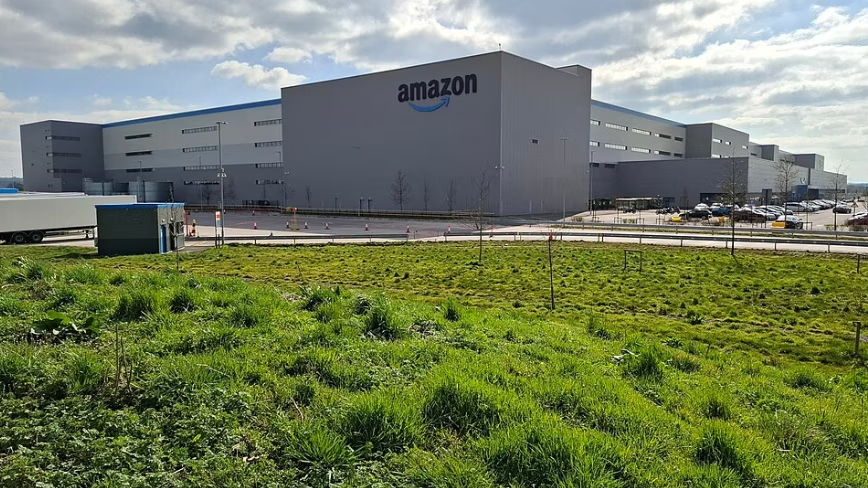
Image: courtesy of Thenextweb
Amazon's AGI Retreat: Why the Tech Giant Quit the Race for Human-Level AI
Amazon has closed its Artificial General Intelligence (AGI) Lab and laid off some employees within the unit, signaling a significant shift in its high-stakes AI strategy. The lab, established in December 2024 and operational for only about 18 months, saw key talent departures, including co-founder David Luan and top AGI executive Rohit Prasad, prior to its closure. Amazon states it is now sharpening its focus on customer-facing AI applications and continues to invest heavily in developing large AI models, but this move suggests a strategic withdrawal from the most ambitious frontier of AI development, where it has struggled to gain a leading position against rivals like OpenAI and Google.
Outlook
Background
The closure of Amazon's AGI Lab, confirmed on July 24, 2026, marks a notable moment in the rapidly accelerating artificial intelligence sector. Artificial General Intelligence, or AGI, refers to a theoretical form of AI capable of understanding, learning, and applying intelligence across a wide range of tasks, much like a human, rather than being limited to a specific function. It represents the ultimate ambition for many AI researchers and a monumental technical challenge.
Amazon's AGI unit was founded in December 2024, an aggressive push to compete with industry leaders who had already established significant leads in foundational AI model development. The lab initially built its core team by recruiting several dozen employees from the startup Adept, including its co-founder and CEO, David Luan. At its peak, the team expanded to approximately 80 individuals.
However, the lab's tenure was brief. Over the past year, more than a dozen of the original Adept hires, including Luan, reportedly left the company. Adding to the leadership exodus, Rohit Prasad, the executive overseeing Amazon's broader AGI initiatives, departed late last year or in recent months. These departures preceded the lab's official shutdown and the subsequent layoffs. An Amazon spokesperson confirmed the job cuts, stating that the company is 'sharpening our focus on the initiatives that matter most for customers, so we can move faster on what counts.' This internal re-evaluation follows broader workforce reductions across Amazon, which included 16,000 job cuts in January 2026.
Precedents
Tech giants have a long history of launching ambitious, often speculative, research labs only to re-evaluate their viability or strategic alignment years later. Projects that appear to promise transformative breakthroughs often demand immense capital, highly specialized talent, and a tolerance for extended periods without tangible commercial returns. Google's X Development (formerly Google X), for instance, has spun out successful ventures like Waymo but also shelved numerous projects that didn't meet internal milestones.
In the AI space specifically, the race for foundational models and AGI has intensified dramatically over the past few years. Companies like OpenAI, Google DeepMind, and Microsoft have committed billions to developing increasingly powerful models, often through extensive academic partnerships and talent acquisitions. This environment creates immense pressure on any new entrant, regardless of its size, to demonstrate rapid progress and attract top-tier researchers. The costs associated with training cutting-edge models — from vast computing resources to elite salaries — are astronomical, often running into hundreds of millions, if not billions, of dollars.
Historically, companies tend to prune projects that fail to show clear paths to commercialization or fail to keep pace with industry leaders. When a core team experiences significant talent churn, particularly at the leadership level, it often signals underlying challenges with project direction, resource allocation, or internal support. Amazon's decision here echoes similar strategic realignments seen across the tech industry, where the pursuit of 'moonshot' projects eventually gives way to a more pragmatic focus on immediate business value.
Amazon's withdrawal from the explicit pursuit of Artificial General Intelligence has several significant implications, reaching far beyond just the company's internal operations. It signals a potential recalibration of what 'winning' the AI race truly means, shifting emphasis from pure foundational research to practical, customer-centric applications.
For Amazon, this move frees up substantial resources — both financial and human — that were previously dedicated to a highly speculative long-term goal. Instead, these resources can now be channeled into enhancing its existing AI products, like Alexa, its AWS cloud services, and its e-commerce recommendation engines. This could translate into more rapid improvements for consumers and businesses already using Amazon's services, potentially strengthening its competitive edge in practical AI deployment.
For the broader AI industry, Amazon's retreat highlights the intense capital and talent demands of AGI research. It implicitly validates the early leads established by companies like OpenAI and Google, suggesting that catching up in this specific, high-stakes domain is increasingly difficult, even for a company with Amazon's resources. This could lead to a further consolidation of AGI research among a select few well-funded players, potentially limiting diversity in approaches or concentrating power in the hands of fewer entities.
Moreover, the talent exodus from Amazon's AGI unit could benefit rival firms. Highly specialized AGI researchers are in high demand, and those laid off will likely find new homes at other leading AI labs, potentially accelerating projects elsewhere. This 'brain drain' could indirectly strengthen Amazon's competitors, even as Amazon itself refocuses.
Ultimately, this decision underscores a fundamental tension in AI development: the balance between pursuing groundbreaking, theoretical advancements and delivering immediate, tangible value to customers. Amazon appears to be making a clear choice for the latter, a move that could redefine its position in the evolving AI ecosystem.
Scenarios
Analysis1. Amazon doubles down on practical, customer-facing AI: This is the most direct inference from Amazon's official statement. By redirecting resources from speculative AGI research, the company could significantly accelerate the development and deployment of AI features in its core businesses. This might include more sophisticated AI for AWS clients, enhanced personalization for e-commerce, or a more capable Alexa. The goal would be to leverage AI to drive immediate business value and strengthen its competitive position in specific application areas, rather than in foundational model leadership. This strategy may lead to a more robust, integrated AI experience across Amazon's product ecosystem, potentially increasing customer loyalty and market share in key segments.
2. Increased consolidation of AGI research among a few key players: Amazon's withdrawal could further concentrate the pursuit of AGI in the hands of the current frontrunners – primarily OpenAI, Google, and Microsoft. With one less major player investing heavily in this specific, high-risk area, the competitive landscape for foundational AGI research becomes less crowded at the very top. This could allow the remaining leaders to accelerate their efforts, potentially leading to faster breakthroughs but also raising questions about the concentration of power and influence in shaping the future of advanced AI. It could also make it harder for smaller startups to enter the foundational AGI space, given the even higher bar set by the remaining giants.
3. Amazon acquires smaller, specialized AI startups: Instead of building foundational AGI from scratch, Amazon may shift its strategy to acquiring specialized AI startups that have already developed promising models or applications. This 'buy vs. build' approach is common in the tech industry and could allow Amazon to quickly integrate cutting-edge AI capabilities without the long-term, high-risk investment of internal AGI research. Such acquisitions would likely focus on companies that align with Amazon's renewed emphasis on customer-facing or AWS-enhancing AI solutions, offering a faster path to market for advanced features.
Timeline
December 2024
Amazon AGI Lab Founded
Amazon establishes its Artificial General Intelligence (AGI) Lab in San Francisco, reportedly recruiting dozens of employees from the startup Adept, including co-founder David Luan, to spearhead its efforts in advanced AI.
Early 2026
Wider Amazon Layoffs
Amazon announces significant workforce reductions across the company, with reports indicating approximately 16,000 job cuts in January 2026, setting a backdrop of broader strategic re-evaluation.
Prior to July 2026
Key Talent Departures
More than a dozen original Adept hires, including David Luan, reportedly leave Amazon's AGI unit. Rohit Prasad, the top executive overseeing AGI, also departs around this period, signaling internal challenges.
July 24, 2026
AGI Lab Closure and Layoffs Confirmed
Amazon confirms the closure of its AGI Lab and layoffs within the AGI unit. A spokesperson states the company is 'sharpening our focus on the initiatives that matter most for customers,' indicating a strategic pivot away from foundational AGI research.
Frequently Asked Questions
AGI stands for Artificial General Intelligence. It refers to a theoretical type of AI that possesses human-like cognitive abilities, capable of understanding, learning, and applying intelligence to any intellectual task, rather than being limited to specific, pre-defined functions. Unlike current 'narrow AI' systems, which excel at tasks like playing chess or recognizing faces, AGI would be able to perform a wide range of tasks, adapt to new situations, and reason abstractly.
Discussion
Be the first to share your thoughts.