
By the close of 2026, Amazon intends for its Prime Air drone delivery service to be operational in approximately 500 communities across the United States. This expansion would dramatically widen the availability of drone-delivered packages, shifting the service from a limited trial in a few select areas to a more widespread, though still targeted, option for a significant segment of the population. Consumers in these areas could see small, lightweight items delivered directly to their homes via autonomous drones, potentially reducing delivery times to under an hour for eligible orders. The company's success or struggle in meeting this target will offer a critical read on the viability of large-scale drone logistics.
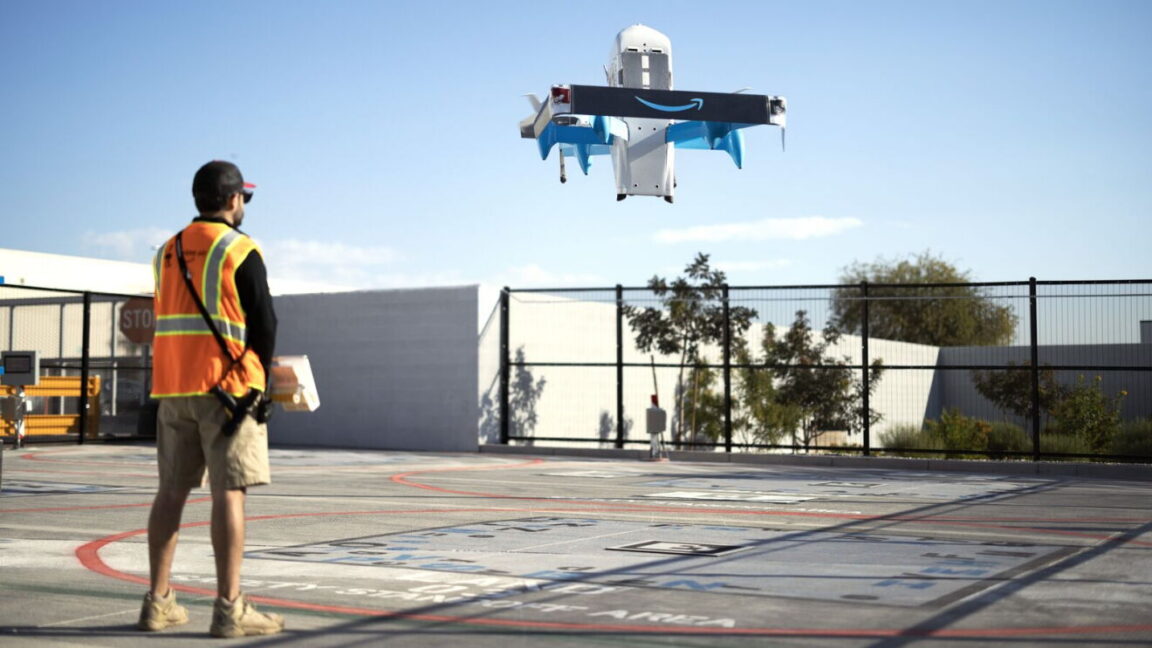
Image: courtesy of Ars Technica
Amazon's Drone Ambition: What 500 US Cities Will Actually Mean for Delivery by 2026
Amazon has announced an aggressive expansion of its Prime Air drone delivery service, aiming to reach nearly 500 US cities and towns by the end of 2026. This sixfold increase from its current footprint signals a major push into automated last-mile logistics, promising faster and potentially cheaper deliveries for lightweight packages to tens of millions of customers. The move intensifies the competition among retailers and delivery companies to streamline the final leg of the supply chain, but it also raises significant questions about the operational, regulatory, and social hurdles Amazon must overcome to achieve such a rapid rollout.
Outlook
Background
On Wednesday, August 19, 2026, Amazon confirmed its plan to expand its Prime Air drone delivery service to nearly 500 US cities and towns by the end of 2026. This represents a substantial, sixfold increase from its current operational footprint, which covers 11 delivery sites across seven states. The retail giant's stated goal is to enhance last-mile delivery efficiency, offering speedy deliveries of lightweight packages to tens of millions of customers. This move positions Amazon at the forefront of a heated race among retailers and logistics firms to make the final leg of package delivery faster and more cost-effective. While the promise of near-instant gratification for online orders is compelling, the path to widespread drone adoption is complex, involving navigating a patchwork of regulations, ensuring public safety, and gaining community acceptance.
Precedents
Amazon first publicly revealed its drone delivery ambitions over a decade ago, with a high-profile announcement in 2013. The initial vision was bold, but the actual deployment of Prime Air has been notably slow and cautious. For years, the service remained in a highly experimental phase, facing significant technical and regulatory hurdles. Limited trials began in earnest only in the mid-2020s, gradually expanding to a handful of locations. This pattern of ambitious announcements followed by gradual, often challenging, real-world implementation is not unique to Amazon or drone technology. Other disruptive technologies, from self-driving cars to commercial space travel, have followed similar trajectories, where the initial hype far outpaces the practical realities of scaling. The difference now is the sheer scale of Amazon's stated intent, moving beyond incremental growth to a truly exponential expansion target within a tight timeframe. This suggests a perceived maturation of the underlying technology and, critically, a more streamlined regulatory environment, particularly regarding federal airspace approvals.
Amazon's aggressive push into drone delivery is not just about faster package arrivals; it represents a significant inflection point in the broader logistics industry and consumer expectations. If successful, this expansion could fundamentally reshape the economics of last-mile delivery, a notoriously expensive and carbon-intensive part of the supply chain. For Amazon, it offers a potential competitive edge, allowing it to fulfill its 'Prime' promise of speed more consistently and perhaps more profitably. For consumers, it means a new tier of convenience, but also potential trade-offs, such as increased drone traffic, noise, and privacy concerns in their neighborhoods. Beyond Amazon, this move could force traditional logistics providers and other retailers to accelerate their own drone or automated delivery initiatives, leading to a broader industry transformation. It also puts immense pressure on regulatory bodies, particularly the Federal Aviation Administration (FAA), to establish clear, scalable, and safe operational frameworks for widespread drone activity across diverse urban and rural environments. The outcome of this expansion will provide a critical test case for how quickly and smoothly the integration of autonomous aerial vehicles into daily life can occur, setting precedents for future technological adoptions.
Scenarios
AnalysisAmazon's stated goal of reaching 500 US cities and towns by the end of 2026 presents several potential outcomes, each with its own set of implications:
Outcome 1: Amazon Achieves Significant, Though Not Necessarily Full, Expansion
One likely scenario is that Amazon makes substantial progress towards its 500-city target, but falls short of full saturation. The company has a proven track record of setting ambitious goals and leveraging its vast resources to achieve them, even if it requires adjustments along the way. In this outcome, Prime Air would become a noticeable presence in dozens, if not hundreds, of new communities. This would mean a significant portion of the US population gains access to drone delivery for lightweight items, solidifying Amazon's position as a leader in automated logistics. The expansion would likely focus on areas with favorable regulatory conditions, adequate infrastructure for drone operations, and communities open to the concept. This partial success would still put immense pressure on competitors to accelerate their own drone programs and could prompt further regulatory streamlining at both federal and local levels. The primary challenges would remain the complex interplay of local ordinances, varying public acceptance, and the sheer logistical effort of deploying and managing hundreds of new drone hubs and thousands of drones.
Outcome 2: Operational and Regulatory Hurdles Limit Rapid Scale
Another plausible outcome is that the inherent complexities of scaling drone delivery, particularly the regulatory and public acceptance challenges, prove more formidable than anticipated. While federal airspace rules from the FAA are evolving, local communities often have their own concerns regarding noise, privacy, and safety. Establishing operational sites, securing local permits, and integrating drone operations into existing infrastructure across hundreds of diverse municipalities can be a slow, fragmented process. Weather limitations, technical glitches, and the need for robust safety protocols could also slow deployment. In this scenario, Amazon might find itself making slower, more incremental progress, perhaps only reaching a fraction of its 500-city target by the end of 2026. This would indicate that while the technology is maturing, the 'last mile' of social and regulatory integration remains a significant bottleneck. Such a slowdown could push back widespread drone delivery by several years, allowing competitors to catch up or refine their own approaches, and potentially leading Amazon to re-evaluate its expansion strategy, perhaps focusing on fewer, more densely populated, or strategically important regions.
Timeline
2013-12-01
Amazon Reveals Prime Air Concept
Amazon CEO Jeff Bezos first unveiled the concept of drone delivery, Prime Air, during an interview, showcasing early prototypes and outlining a vision for package delivery within 30 minutes.
2016-12-07
First Customer Drone Delivery in UK
Amazon conducted its first successful customer drone delivery in Cambridge, England, delivering an Amazon Fire TV stick and a bag of popcorn to a rural customer in 13 minutes.
2020-08-31
FAA Approves Amazon Prime Air as Air Carrier
The US Federal Aviation Administration (FAA) granted Amazon Prime Air an Air Carrier Certificate, allowing it to operate as an airline and conduct commercial drone deliveries, a crucial step for wider operations.
2022-06-13
First US Drone Deliveries Announced
Amazon announced its first US drone delivery service would launch later in the year in Lockeford, California, and College Station, Texas, marking the beginning of limited public operations.
2026-08-19
Amazon Announces Sixfold Expansion Target
Amazon publicly announced its ambitious plan to expand the Prime Air drone delivery service to nearly 500 US cities and towns by the end of 2026, a sixfold increase from its current footprint.
2026-12-31
Target Expansion Deadline
The end-of-year deadline for Amazon to achieve its target of operating Prime Air drone delivery services in nearly 500 US cities and towns.
Frequently Asked Questions
Amazon Prime Air is the company's drone delivery service, designed to deliver lightweight packages to customers using autonomous aerial vehicles, typically within 30 minutes of ordering.
Discussion
Be the first to share your thoughts.