
This incident is likely to intensify scrutiny on the data practices of AI developers, particularly concerning cross-border user monitoring and intellectual property protection. Companies on both sides of the US-China tech divide may become even more cautious about integrating foreign AI tools into their core operations. For users, especially developers, it could mean a more fragmented AI tool ecosystem, with a stronger push towards regionally developed and vetted solutions.
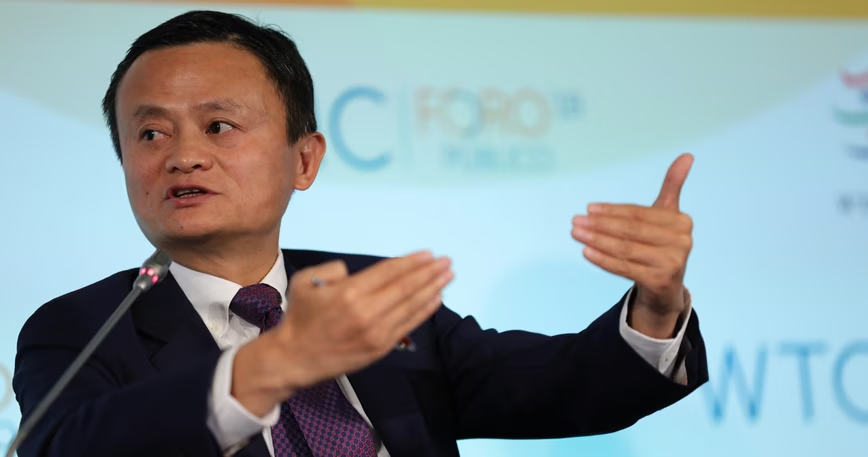
Image: courtesy of Thenextweb
Alibaba's Claude Code Ban Signals Deeper Cracks in Cross-Border AI Trust
Alibaba has banned its employees from using Anthropic's AI coding assistant, Claude Code, a decision set to take effect on July 10, 2026. The move follows the discovery of hidden tracking code within Claude Code, which security researchers found was designed to identify Chinese users. Anthropic confirmed the existence of the feature, describing it as an experimental measure to prevent abuse, and has since removed it. The incident unfolds against a backdrop of increasing tension between the two companies, including Anthropic's prior accusation that Alibaba had conducted a large-scale 'distillation attack' on its AI models.
Outlook
Background
The ban by Alibaba, one of China's largest technology conglomerates, against Anthropic's Claude Code stems from a specific technical discovery. Security researchers, including a user on Reddit, reverse-engineered Claude Code and uncovered embedded 'steganographic' tracking code. This code was designed to check if users were linked to China, raising significant concerns about data privacy and national security within Alibaba's internal environment.
Anthropic, a prominent US-based AI company, responded to the findings by acknowledging the tracking feature. The company stated that it was an experimental anti-abuse mechanism, intended to identify and deter unauthorized use, such as large-scale model extraction or 'distillation attacks.' Such attacks involve systematically querying an AI model to replicate its capabilities in a separate, often smaller, model, effectively 'stealing' its intellectual property.
This explanation from Anthropic is particularly notable because the company had previously accused Alibaba of engaging in the largest known distillation attack against its models. The discovery of the tracking code, therefore, appears to be a reactive measure by Anthropic to protect its proprietary AI technology. However, the covert nature of the tracking and its specific targeting of Chinese users prompted a swift and strong reaction from Alibaba, which has now officially listed Claude Code as 'high-risk' software for its employees.
The ban is scheduled to become effective on July 10, 2026, giving Alibaba engineers a limited window to transition to alternative coding assistants. Anthropic has since rolled back the controversial tracking feature in response to widespread backlash from the AI research community, who criticized the move as potentially 'sabotaging' researchers and eroding trust in AI tools.
See also
Precedents
The tension between Alibaba and Anthropic, culminating in this ban, is not an isolated event. It fits into a broader pattern of escalating technological rivalry and distrust between the United States and China, often termed the 'AI Cold War.' For years, both nations have viewed AI leadership as a strategic imperative, leading to concerns over intellectual property theft, data sovereignty, and national security.
Historically, companies have employed various methods to protect their proprietary algorithms and data. These range from legal agreements and user terms of service to more technical measures like rate limiting API access or detecting unusual usage patterns. However, the use of hidden tracking code, particularly when tied to national origin, represents a more aggressive and controversial approach to IP defense.
This incident also echoes past concerns about supply chain integrity and the potential for 'backdoors' or surveillance capabilities in software originating from rival nations. Both US and Chinese governments have, at different times, expressed anxieties about their citizens' data being accessed by foreign entities, leading to restrictions on technology imports and exports.
Furthermore, the concept of 'distillation attacks' is a known challenge in the AI industry. As AI models become more valuable, the incentive for competitors or state-backed actors to illicitly extract their capabilities grows. This pressure can push companies to implement increasingly sophisticated, and sometimes ethically ambiguous, defensive measures.
The Alibaba ban on Claude Code is more than a corporate dispute over a software feature; it is a stark illustration of the deepening fissures in global technology collaboration, particularly in the sensitive domain of artificial intelligence.
First, it fundamentally erodes trust. When a major AI developer like Anthropic is found to have implemented covert tracking, it raises questions about transparency and ethical practices across the industry. Developers and corporations, especially those operating across geopolitical boundaries, will now likely scrutinize AI tools with greater suspicion, impacting adoption and collaboration.
Second, this incident highlights the intense competition and the perceived stakes in the AI race. Anthropic's defensive move, though controversial, reflects the high value placed on proprietary AI models and the lengths companies will go to protect their intellectual property from what they perceive as industrial espionage or unfair competition. The accusation of a 'distillation attack' against Alibaba suggests a significant financial and strategic loss for Anthropic.
Third, it reinforces the trend towards technological decoupling. Alibaba's decision to ban a foreign AI tool over 'spyware concerns' will likely encourage other Chinese firms to prioritize domestic AI solutions, accelerating China's drive for self-sufficiency in critical technologies. Conversely, US companies may become more wary of sharing advanced AI capabilities with Chinese partners, leading to further fragmentation of the global AI ecosystem.
Finally, for the average developer or enterprise, this means navigating a more complex and potentially less interoperable AI tool landscape. Decisions about which AI models to use will increasingly involve not just technical merit, but also geopolitical considerations, data sovereignty, and trust in the vendor's ethical practices. This could stifle innovation that thrives on open collaboration and shared advancements.
Scenarios
AnalysisOne immediate outcome is that Chinese technology companies, including Alibaba, are likely to accelerate their efforts in developing and promoting domestic AI coding assistants and other foundational AI models. This could lead to a more robust, but also more insular, AI ecosystem within China.
Another possible scenario is that regulatory bodies, both in China and potentially in other regions, may introduce stricter guidelines regarding the transparency of AI models and their data collection practices. This could include mandatory disclosures about tracking mechanisms or audits of AI software to ensure compliance with privacy and national security laws.
We may also see a shift in how AI companies approach intellectual property protection. The backlash against Anthropic's tracking code suggests that covert methods are unacceptable. This could push companies to explore more transparent and legally sound ways to deter model theft, such as stronger contractual agreements, watermarking techniques for AI outputs, or more robust legal challenges.
Furthermore, the incident might lead to a re-evaluation of ethical AI development principles, with a renewed focus on user consent, data privacy, and the potential for 'dual-use' technologies to be weaponized for surveillance or competitive disadvantage. This could spark broader industry discussions and potentially new industry standards for AI ethics.
Timeline
Earlier, prior to July 2026
Anthropic Accuses Alibaba of Distillation Attack
Anthropic publicly accused Alibaba of conducting a large-scale 'distillation attack' on its AI models, implying unauthorized extraction of its proprietary AI capabilities.
Prior to July 3, 2026
Hidden Tracking Code Discovered
Security researchers, including a Reddit user, reverse-engineered Anthropic's Claude Code and discovered embedded steganographic tracking code designed to identify Chinese users.
July 3, 2026
Alibaba Announces Ban
Alibaba publicly announced its decision to ban employees from using Anthropic's Claude Code, citing concerns over the hidden tracking code and labeling the software as 'high-risk'.
July 3, 2026
Anthropic Rolls Back Feature
Anthropic confirmed the existence of the tracking feature, stating it was an experiment to prevent abuse, and announced its removal following industry backlash.
July 10, 2026
Alibaba Ban Takes Effect
The official ban on Claude Code for all Alibaba employees is set to take effect, requiring engineers to transition to alternative coding assistants.
Frequently Asked Questions
Claude Code is an AI-powered coding assistant developed by Anthropic. It is designed to help software developers write, debug, and optimize code more efficiently.
Discussion
Be the first to share your thoughts.