
Investors and industry observers can anticipate 01.ai's Hong Kong IPO process to formally begin in 2027. The company's valuation and market reception will offer a critical gauge of investor confidence in the enterprise AI infrastructure model, particularly within the Chinese market. The success of this offering could influence other Chinese AI startups contemplating their own monetization and market strategies, potentially encouraging a broader shift away from direct LLM competition towards specialized application layers.
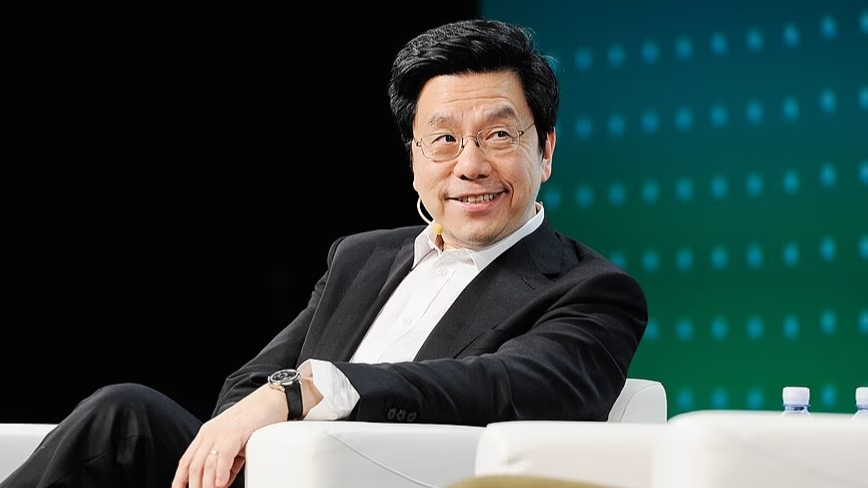
Image: courtesy of Thenextweb
Kai-Fu Lee's 01.ai Abandons LLM Race for Enterprise AI Infrastructure, Eyes Hong Kong IPO: What This Means for China's AI Ambitions
AI pioneer Kai-Fu Lee's startup, 01.ai, has made a significant strategic pivot, shifting its focus from developing large language models (LLMs) to building and selling enterprise AI infrastructure. The company, which launched its first LLM in late 2023, confirmed this change in March 2025. Now, 01.ai is preparing for a Hong Kong IPO in 2027, positioning itself as the 'Palantir of China' with a product called 'Boss AI' that emphasizes on-premises data integration and security for large organizations.
Outlook
Background
Kai-Fu Lee, a prominent figure in the global artificial intelligence landscape with a career spanning leadership roles at Google China and Microsoft, founded 01.ai in Beijing in March 2023. The startup initially aimed to develop its own large language models tailored for the Chinese market, releasing its Yi-34B model in November 2023.
However, a significant strategic reorientation occurred in March 2025. 01.ai ceased its in-house LLM development, instead pivoting to focus on enterprise AI infrastructure. This new direction centers on helping large organizations integrate and make sense of their internal, often disconnected, data pools. The company's flagship product, dubbed 'Boss AI,' is designed to allow executives to query and visualize this data instantly, with a strong emphasis on data security through on-premises deployment.
Lee has publicly drawn a parallel between 01.ai and Palantir, a U.S. data analytics company known for its work with government agencies and large corporations, by referring to his venture as the 'Palantir of China.' This comparison highlights the ambition to provide deeply embedded, secure data solutions. The strategic shift comes as Lee also predicts that 2026 will be a pivotal year for the emergence of AI agents, which would inherently rely on robust data infrastructure to function effectively. 01.ai is a flagship company for Sinovation Ventures, Lee's venture capital firm, which manages US$3 billion in dual-currency funds and focuses on deep-tech companies.
Precedents
The trajectory of 01.ai mirrors a broader pattern seen in the evolution of foundational technologies. In the early days of any major technological wave – be it the internet, cloud computing, or now AI – the initial race often focuses on building the core infrastructure or foundational models. However, as these foundational layers mature and become more commoditized, the real value, and often the most viable revenue streams, shift towards specialized applications and services built on top of them.
For AI, this means that while the initial hype centered on developing ever-larger and more capable LLMs, the immense computational costs and the rapid proliferation of open-source or easily accessible models have made direct monetization a challenge for many startups. The pivot towards enterprise infrastructure suggests a recognition that the 'gold rush' is not necessarily in selling the picks and shovels (the LLMs themselves), but in building the processing plants and transportation networks that allow businesses to extract value from the gold (their data) using these tools.
Historically, companies like Palantir, to which Lee compares 01.ai, have demonstrated the viability of this model by providing complex, customized data integration and analytics solutions for high-value enterprise and government clients. Their success hinges not on creating the underlying database technology, but on making disparate data actionable and secure. Similarly, the trend for Chinese tech companies to seek listings in Hong Kong has strengthened in recent years, partially due to increased regulatory scrutiny and geopolitical tensions surrounding listings in the United States. Hong Kong offers a familiar market closer to home, albeit with its own set of regulatory and investor considerations.
01.ai's strategic pivot carries significant implications for the broader artificial intelligence industry, particularly in China. It signals a potential shift in how venture-backed AI companies seek to achieve profitability and scale, moving beyond the capital-intensive and fiercely competitive domain of foundational model development.
For enterprises, this change highlights a growing understanding that raw AI models are only as valuable as the data they can access and process securely. Companies are increasingly grappling with vast, siloed datasets that remain largely untapped. A solution like 'Boss AI,' which promises to knit these disparate pools together and allow for instant querying, addresses a critical operational bottleneck. The emphasis on on-premises deployment also speaks to rising concerns around data governance, privacy, and sovereignty, especially for large organizations in sensitive sectors.
Furthermore, Kai-Fu Lee's stature in the AI world means his strategic choices often influence the wider ecosystem. His move away from core LLM development could validate similar pivots for other Chinese startups that might be struggling to differentiate or monetize their own foundational models. This could lead to a more diversified and robust AI industry in China, with greater focus on practical, revenue-generating applications rather than solely on technological breakthroughs. The Hong Kong IPO, if successful, would also provide a crucial funding pathway for a new generation of enterprise AI companies, potentially opening up new avenues for capital allocation in the region.
Scenarios
AnalysisThe upcoming Hong Kong IPO for 01.ai in 2027, following its pivot to enterprise AI infrastructure, presents several distinct possibilities for the company and the broader market.
One possible outcome is that 01.ai successfully executes its IPO, attracting strong investor interest and achieving a robust valuation. This scenario would likely be driven by a clear demonstration of revenue growth from its 'Boss AI' platform and a strong pipeline of enterprise clients, particularly those concerned with data security and on-premises solutions. A successful listing would validate Kai-Fu Lee's strategic shift, potentially encouraging other Chinese AI startups to re-evaluate their own business models and consider similar pivots towards specialized enterprise applications. This could lead to a more mature Chinese AI market, where value creation is less about raw model power and more about effective, secure deployment within specific business contexts.
Conversely, 01.ai could face significant challenges in its IPO and in scaling its enterprise infrastructure business. The market for enterprise software, especially complex data integration tools, is highly competitive, featuring both established players and other nimble startups. Convincing large organizations to adopt new core data infrastructure can be a long sales cycle, requiring extensive customization and trust-building. If 01.ai struggles to secure a substantial number of high-value contracts or faces unexpected technical hurdles in integrating diverse enterprise systems, investor appetite for its IPO could be dampened, leading to a lower-than-anticipated valuation or even a delay. Geopolitical factors and broader market sentiment towards Chinese tech listings in Hong Kong could also influence the outcome.
A third scenario suggests that while the IPO may proceed, 01.ai's long-term success will hinge on its ability to continuously adapt to the rapidly evolving AI landscape. Lee's own prediction about the rise of AI agents in 2026 implies a future where AI systems become increasingly autonomous and capable of complex tasks. For 'Boss AI' to remain relevant, it would need to evolve beyond mere data visualization to become a foundational layer for these agents, enabling them to securely access and act upon enterprise data. Failure to anticipate or integrate these next-generation AI functionalities could limit 01.ai's growth potential, even if its initial IPO is successful.
Timeline
2023-03-01
01.ai Founded
Dr. Kai-Fu Lee establishes 01.ai in Beijing, initially focusing on developing large language models (LLMs) for the Chinese market.
2023-11-01
Yi-34B LLM Released
01.ai releases its first large language model, Yi-34B, marking its entry into the foundational model space.
2025-03-01
Strategic Pivot Announced
01.ai officially shifts its business focus, ceasing in-house LLM development to concentrate on enterprise AI infrastructure, with an emphasis on data security and on-premises deployment.
2026-07-20
Hong Kong IPO Plans Confirmed
News emerges that 01.ai is preparing for a Hong Kong IPO, targeting 'next year' (2027) for the public offering, following its strategic pivot.
2027-01-01
Anticipated IPO Window
01.ai is expected to launch its initial public offering in Hong Kong, subject to market conditions and regulatory approvals.
Frequently Asked Questions
01.ai has pivoted from building its own large language models to developing and selling enterprise AI infrastructure. Its product, 'Boss AI,' helps large organizations integrate, query, and visualize their internal data securely, often through on-premises deployment.
Discussion
Be the first to share your thoughts.