
The influx of capital from this bond sale is expected to immediately impact SpaceX's financial structure, allowing it to replace higher-interest bridge financing with more cost-effective investment-grade debt. This financial maneuver provides the company with substantial liquidity to execute its aggressive AI strategy, which includes expanding data center capacity, developing new AI models, and potentially acquiring more AI-focused startups. The market will be watching closely for how quickly SpaceX integrates these AI capabilities into its existing operations and whether these investments translate into tangible new revenue streams or operational efficiencies. Further deals and partnerships in the AI space are likely as SpaceX works to deploy this capital.
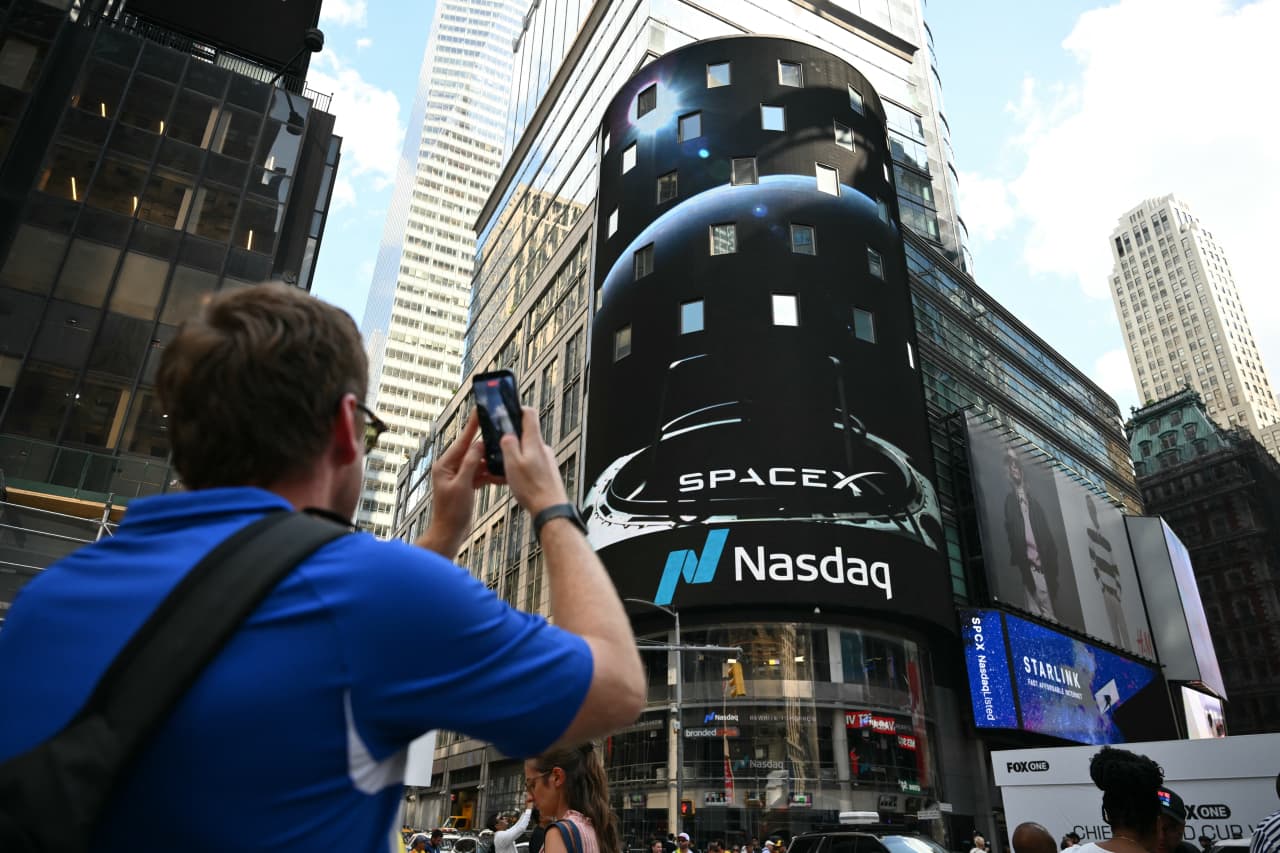
Image: courtesy of Market Watch
SpaceX Fuels AI Ambitions with $25 Billion Debt Deal After Record IPO
SpaceX, the rocket and satellite internet company led by Elon Musk, has raised $25 billion through a bond sale, attracting an overwhelming $89 billion in demand from investors. The financing, secured just months after its record-setting $75 billion initial public offering, is primarily earmarked for refinancing existing bridge loans and accelerating the company's significant push into artificial intelligence initiatives, including a $6 billion deal with Reflection AI and an option to acquire Cursor. This move signals a broader trend among major tech firms leveraging debt markets to fund the escalating costs of AI development and infrastructure.
Outlook
Background
SpaceX has been a dominant force in the space industry, known for its reusable rockets and the Starlink satellite internet constellation. Earlier this year, the company achieved a major financial milestone with a $75 billion IPO, making it one of the largest public market debuts in recent history. Despite this substantial capital infusion, SpaceX opted to tap the debt markets, securing $25 billion in investment-grade bonds. The demand for these bonds was notably high, reaching $89 billion, indicating strong investor confidence in the company's financial health and strategic direction.
A significant portion of these funds is specifically allocated to artificial intelligence projects. This includes a confirmed $6 billion deal with AI startup Reflection AI for data-center space, a critical component for AI model training and deployment. Furthermore, SpaceX acquired xAI, another AI venture founded by Elon Musk, earlier this year. The company also holds an option to acquire the AI code-generation startup Cursor for $60 billion this year, with a $10 billion fee if they decide not to proceed. These investments highlight a multi-pronged approach to integrating AI across SpaceX's diverse operations, from optimizing rocket launches to enhancing Starlink's network capabilities and developing advanced AI products.
See also
Precedents
The strategy of leveraging debt markets to fund ambitious growth projects, even after a substantial IPO, is not new for large, capital-intensive companies. Historically, firms with strong credit profiles use debt as a cheaper alternative to equity financing, especially when interest rates are favorable or when they need to fund specific, long-term assets like data centers or research initiatives. For instance, major telecommunications companies have routinely borrowed heavily to build out network infrastructure, and semiconductor firms have used debt to finance costly fabrication plants.
The current wave of AI development is drawing parallels to the dot-com boom in its demand for capital, but with a key difference: many of the companies leading the AI charge, like SpaceX, possess established revenue streams and market positions, allowing them access to investment-grade debt. This contrasts with earlier, more speculative tech booms where much of the funding came from venture capital or high-yield bonds for unproven entities. The ability of a company like SpaceX to secure investment-grade financing, as opposed to a newer AI cloud provider like CoreWeave which raised high-yield debt at around 9% interest, demonstrates the market's differentiation based on overall corporate stability and perceived execution risk. Companies like Oracle, while having significant debt, are only two ratings above junk status, indicating that even established players can face higher borrowing costs if their financial ratios are less compelling than market leaders.
This $25 billion debt deal is more than just a financial transaction for SpaceX; it's a clear signal of where capital is flowing in the current technology cycle. The commitment to AI, funded through the bond market, indicates a strategic pivot and an acknowledgment that AI is no longer just a software layer but a fundamental infrastructure component for future growth, even for a company primarily known for rockets and satellites.
For investors, the high demand for SpaceX's bonds, despite the company's recent IPO, reflects strong confidence in its ability to manage debt and generate returns from its AI investments. It also suggests that the market sees SpaceX as a diversified technology player, not just a space company, with significant potential in the AI sector.
For the broader tech industry, SpaceX's move could set a precedent. As the 'AI arms race' intensifies, other well-capitalized firms may increasingly turn to debt markets to fund their own AI infrastructure, rather than diluting equity or relying solely on cash flow. This could further depress borrowing costs for companies with strong balance sheets and accelerate the deployment of AI capabilities across various sectors, creating both opportunities and competitive pressures. The deal also highlights the sheer scale of capital required to compete at the forefront of AI development, making it increasingly difficult for smaller players to keep pace without significant external financing.
Scenarios
AnalysisOne potential outcome is that SpaceX's substantial investment in AI, backed by this debt financing, significantly accelerates its technological advancements and market diversification. By integrating AI into its space operations, satellite internet, and potentially new ventures, SpaceX could gain a substantial competitive edge. This might lead to enhanced operational efficiency, new revenue streams from AI-powered services, and a stronger valuation as a leading AI and space technology firm. The successful execution of its AI strategy could solidify its position at the intersection of these two critical future industries.
Conversely, a second outcome could see SpaceX face considerable execution challenges or intense competition in the rapidly evolving AI sector. The sheer scale of the investment in AI, including the potential $60 billion acquisition of Cursor, carries inherent risks. If the returns on these AI investments are slower than anticipated, or if the technology does not perform as expected, it could strain SpaceX's financial position, despite the favorable debt terms. The competitive landscape in AI is fierce, with established tech giants and well-funded startups vying for talent and market share. This could lead to a protracted period of high capital expenditure without immediate, commensurate returns, potentially impacting future profitability and investor sentiment.
A third possibility is that this debt deal becomes a bellwether for how large, capital-intensive AI projects are financed across the technology sector. If SpaceX successfully demonstrates that investment-grade debt is a viable and efficient mechanism to fund AI infrastructure and development, it could encourage other companies to adopt similar strategies. This would further deepen the bond market's role in the AI economy, potentially leading to more standardized financing structures and increased scrutiny on the long-term viability of AI investments from credit rating agencies.
Timeline
Frequently Asked Questions
Discussion
Be the first to share your thoughts.